
Hey there! If you’re exploring home education in England, you’ll almost certainly come across the term SEN, which stands for Special Educational Needs. It’s a really important concept!
Understanding SEN (Special Educational Needs) in Home Education
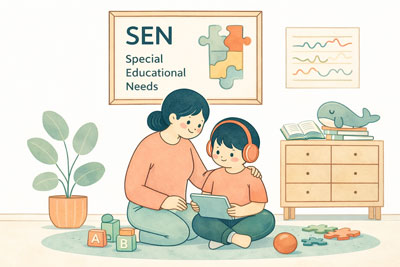
SEN (Special Educational Needs) is a term used to describe a child who needs extra or different support compared to most children of the same age, to help them learn and develop.
This could include a wide range of needs, for example learning differences, communication challenges, physical needs, emotional or sensory needs. Every child with SEN is different, and support should be tailored to the individual.
- It’s about the child, not the label: SEN covers a wide range of needs, and each child’s situation is unique.
- It affects what “suitable education” means: education must be appropriate for your child’s needs, not just their age.
- It does not prevent home education: children with SEN can be home educated lawfully.
In the context of home education, SEN matters because of how it links to Section 7 of the Education Act 1996. The law says education must be suitable to a child’s age, ability, aptitude and any special educational needs. That means what is “suitable” can look very different for a child with SEN.
For many families, home education is chosen precisely because it allows learning to be more flexible, personalised, and responsive to a child’s needs. That might mean adjusting pace, focusing on strengths, or supporting wellbeing alongside academic learning.
Related: EHCP
Some children with SEN also have an Education, Health and Care Plan (EHCP). This can affect how home education works in practice, especially if a child is attending a special school or if consent is needed before deregistration. In these situations, the exact details matter, so it’s worth checking your specific circumstances carefully.
In day-to-day life, what helps most is having a clear understanding of your child’s needs and being able to show how your approach supports them. This doesn’t need to be complicated; simple records, observations, and examples of learning can often tell the story well.
So, in short: SEN (Special Educational Needs) refers to a child needing additional or different support to learn effectively. In home education, it plays a key role in shaping what a suitable education looks like for that child.
What does SEN (Special Educational Needs) mean to you?
If you have got something to add to our SEN (Special Educational Needs) page, please do let us know.