
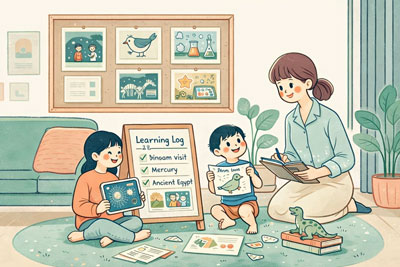
Evidence of learning: what actually counts?
For home education in England, there is no single required format for showing learning. What matters is whether you can show that your child is receiving an education that is efficient, full-time and suitable for their age, ability, aptitude and any special educational needs.
Evidence does not have to look like school
It does not have to be worksheets, formal tests, school hours or national curriculum boxes. Home education can look different from school and still be suitable.
Evidence should make learning visible
The best evidence helps someone else understand what your child has been doing, what they are learning, and how that learning fits your family’s approach.
Plain-English rule of thumb: good evidence is anything that helps show what your child is doing, what they are learning, and that it is happening consistently over time.

What makes evidence useful in a home education report?
You do not need to overwhelm a local authority with paperwork. In practice, the most helpful evidence is usually clear, dated, and easy to follow.
1. Show what happened
- What activity took place?
- What was explored, practised or discussed?
- Was it child-led, project-based, structured, or mixed?
2. Show the learning
- What knowledge, skills or understanding were developing?
- What did your child create, explain, solve or notice?
- How does this fit their age, interests, ability or needs?
3. Show some continuity
- Dated notes help show learning over time.
- A small timeline is often better than a large pile of documents.
- Consistency matters more than perfection.
4. Keep it readable
- Short explanations are usually enough.
- Use plain language.
- One photo + one sentence is often stronger than ten unlabeled photos.
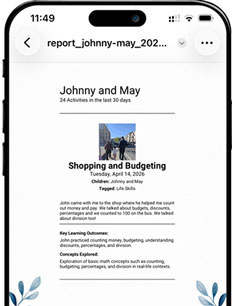
Examples of evidence you can include
Evidence of learning can come from everyday home education, not just written work. A strong home ed report usually combines a few different kinds of evidence.
Notes and learning logs
- Dated notes about activities, interests or projects.
- Short reflections on what was learned.
- A few sentences on progress, confidence or next steps.
Photos with context
- Photos of practical work, trips, making, experiments or reading.
- A one-line explanation of what was happening.
- Why it mattered or what skill was being developed.
Projects and outputs
- Drawings, models, writing samples or presentations.
- Game design, coding, crafts, cooking or science experiments.
- Any finished piece that shows thinking, effort or skill.
Reading and discussion
- Book lists, read-alouds, library visits or articles explored.
- Topics discussed at home.
- How reading connected to wider interests or projects.
Trips, clubs and community learning
- Museum visits, walks, workshops, sports, volunteering or groups.
- Who they met, what they saw, what they tried.
- Skills like communication, teamwork or independence.
Progress over time (learning timeline)
- Examples from different dates.
- How an interest deepened or a skill improved.
- Any adaptation for special educational needs or interests.
Helpful mindset: you do not need to record everything. Choose evidence that gives a clear picture of your child’s learning, your approach, and the consistency of what you are doing.
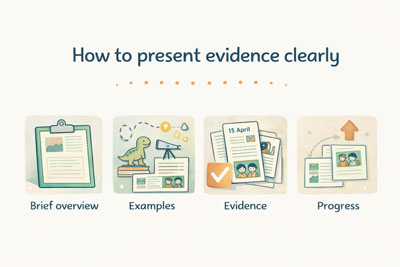
How to present evidence clearly to a local authority
If you ever need to respond to local authority questions, clarity matters more than volume. The aim is not to create school-style paperwork. The aim is to make learning easy to understand.
A simple structure that works well
- Brief overview: your approach to home education.
- Examples: activities, projects, reading, trips and daily learning.
- Evidence: a few dated notes, photos or outputs.
- Progress: what is developing over time.
Questions your evidence should answer
- What is this child learning?
- How is learning happening in practice?
- Is it suitable for this child?
- Is it happening regularly and consistently?
Practical tip: one page of clear examples is usually more persuasive than a large folder with no explanation. Short captions, dates and a simple structure make your evidence much easier to use in a report.
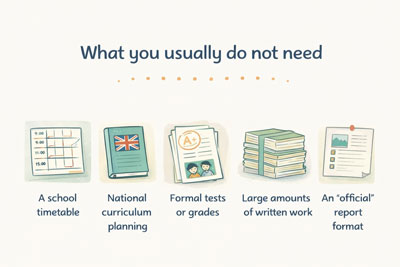
What you usually do not need
Many parents worry that evidence has to look formal. In most cases, it does not.
You do not usually need
- A school timetable.
- National curriculum planning.
- Formal tests or grades.
- Large amounts of written work.
- A fixed “official” report format.
What matters more
- That the education is suitable for your child.
- That you can describe what learning looks like.
- That you can show examples calmly and clearly if needed.
- That your evidence reflects real learning, not paperwork for its own sake.
Want an easier way to keep evidence of learning?
Strew helps you keep dated notes, photos and activities in one place so you can turn everyday learning into a clear, structured record. That makes it much easier to prepare evidence if you ever need to share it with your local authority.