
One phrase that often comes up in home education discussions is “evidence of learning”. It sounds very formal, but in reality it simply means being able to demonstrate what a child has been learning and experiencing over time.
Understanding Evidence of Learning in Home Education
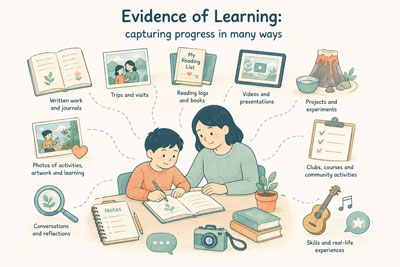
Evidence of learning is any information, activity, work, experience, conversation, project or record that helps show how a child is developing their knowledge, skills, understanding and interests.
Importantly, evidence of learning is not the same as school-style testing. Home educated children can learn in many different ways, and evidence can take many different forms.
- Written work such as stories, reports, worksheets or journals.
- Photographs of practical projects, experiments, artwork or outdoor activities.
- Reading logs, book lists or discussions about books.
- Videos, recordings or presentations.
- Trips, visits, clubs, volunteering and community activities.
- Conversations that demonstrate understanding of a topic.
- Skills learned in everyday life, such as cooking, budgeting, gardening or problem-solving.
Many home educating families do not collect evidence specifically for anyone else. Instead, they keep records because it helps them reflect on their child’s progress, remember achievements, identify interests and create a useful learning history.
Evidence of learning can be especially helpful when creating a home education report, applying for college courses, preparing for exams, demonstrating progress to family members, or responding to enquiries from a local authority.
One common misconception is that evidence of learning must prove that a child is following the National Curriculum. This is not generally the case for home educated children. The purpose is usually to help demonstrate that learning is taking place and that the education being provided is suitable for the individual child.
Evidence can be formal or informal. A photograph of a child building a den, a list of books they have read, notes from a museum visit, or a project exploring local wildlife may all provide valuable evidence of learning. Often, the richest evidence comes from everyday experiences rather than traditional school-style work.
Some families keep extensive portfolios, while others prefer simple notes or occasional summaries. There is no single correct approach. The best system is usually the one that is sustainable enough to continue using over time.
Digital tools have made this easier than ever. Rather than trying to remember months of activities at the end of the year, many parents now log learning as it happens, creating a record that can later be organised into reports, timelines or portfolios.
If you are interested in the legal side of home education, you may also want to read our pages on Suitable Education, Section 7 of the Education Act 1996, and Elective Home Education (EHE).
At Strew, we believe evidence of learning should be easy to capture. That’s why the app allows parents to record activities, photos, books, achievements and learning outcomes throughout the year, helping turn everyday experiences into a clear educational record when needed.
So, in short: evidence of learning is simply anything that helps demonstrate a child’s educational journey. It does not have to look like schoolwork, and it can take many different forms depending on the child and the family’s approach to home education.
What does Evidence of Learning mean to you?
If you’ve got something to add to our Evidence of Learning page, please do let us know.