
Hey there! If you’re home educating in England, you’ll probably come across the phrase “suitable education” quite a lot. It’s one of the key legal ideas behind home education, but it can sound more intimidating than it needs to. Let’s put “Suitable Education” into plain English.
Understanding Suitable Education in Home Education
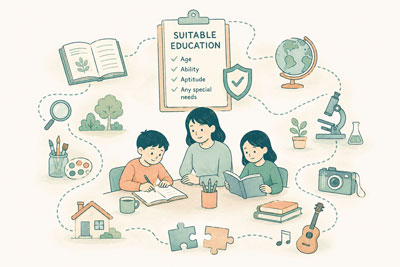
Suitable education means education that is appropriate for your child as an individual. Under Section 7 of the Education Act 1996, parents must make sure their child receives an efficient, full-time education suitable to their age, ability and aptitude, and to any special educational needs they may have.
In home education, “suitable” does not mean your education has to look exactly like school. It does not automatically mean following the National Curriculum, using school hours, sitting at a desk all day, or recreating classroom lessons at home.
- It should fit your child: suitable education depends on your child’s age, ability, aptitude and any special educational needs.
- It can be flexible: home education can be structured, child-led, project-based, practical, conversational, outdoors, online, or a mixture of approaches.
- It should show learning: the main question is whether your child is receiving an education that helps them make progress and develop over time.
For home educating families, suitable education matters because it is the standard local authorities are usually thinking about when they make enquiries. They are not generally checking whether your home education looks like a school timetable. They are trying to understand whether the education being provided appears to meet your child’s needs.
This is where clear examples can really help. You might show suitability through notes about activities, books read, projects completed, conversations, trips, practical skills, creative work, maths, writing, science, history, nature study, life skills, or anything else that forms part of your child’s learning.
If your child has SEN or additional needs, suitable education may look different again. The law specifically says education should be suitable to any special educational needs a child may have. That means a slower pace, a different communication style, sensory adjustments, extra repetition, or a more interest-led approach may all be part of what makes the education suitable for that child.
You may also want to read our pages on Section 7 of the Education Act 1996, Elective Home Education (EHE), and SEN to understand how these terms fit together.
Keeping a simple record of learning can make it easier to explain your approach if you ever need to. Tools like Strew’s home education reports can help turn everyday learning into a clear, structured overview without forcing your home education to look like school.
So, in short: suitable education means education that fits your child’s age, ability, aptitude and needs. In home education, it does not have to follow a school model, but it should be possible to explain how your child is learning and developing over time.
What does Suitable Education mean to you?
If you have got something to add to our Suitable Education page, please do let us know.