
Charlotte Mason Home Education
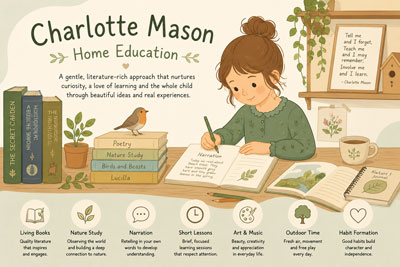
Charlotte Mason home education is a gentle, literature-rich approach built around living books, nature study, narration, habit formation and short, meaningful lessons. It gives children a broad, beautiful education without making home learning feel like school at the kitchen table.
What is Charlotte Mason home education?
Charlotte Mason was a British educator who believed children are born persons, not empty vessels to be filled. Her approach treats children as capable, curious and worthy of rich ideas from the beginning.
In practice, Charlotte Mason home education often means reading high-quality books, spending regular time outdoors, observing nature, discussing ideas, building good habits and allowing children to retell what they have learned in their own words.
It is not usually a worksheet-heavy approach. Instead, it values attention, atmosphere, conversation, beauty and real understanding.
Core features of the Charlotte Mason approach
What does a Charlotte Mason day look like?
A Charlotte Mason day is usually calm, varied and intentional. Younger children may have short lessons in reading, maths or copywork, followed by a story from a living book, nature observation, poetry, handicrafts or time outdoors.
Older children may read from history, literature, science and geography texts, then narrate what they understood. Narration might be spoken, written, drawn or discussed, depending on the child’s age and stage.
Who does Charlotte Mason suit?
Charlotte Mason can work well for families who want a rich education without a highly rigid school timetable. It often suits children who enjoy stories, nature, discussion, art, history, animals, music, observation or hands-on connections to the wider world.
It can also be a good fit for parents who want structure, but not pressure. There is still planning involved, but the day can feel more like a rhythm than a strict schedule.
- Families who enjoy reading aloud and discussing ideas
- Children who learn well through stories and real-world examples
- Parents who want a gentle but purposeful approach
- Families who value nature, creativity and broad learning
- Home educators who want records without turning every activity into formal work
How to record Charlotte Mason learning
Charlotte Mason learning can be easy to underestimate because so much of it happens through reading, conversation, observation and everyday experiences. A child may not produce a pile of worksheets, but that does not mean there is no evidence of learning.
Useful things to record include books read, narrations, nature journal entries, poems learned, practical skills, museum visits, map work, art study, music appreciation, discussions and independent discoveries.
- Book titles and what your child understood from them
- Spoken or written narrations
- Nature walks, seasonal observations and sketches
- Photos of projects, notebooks, maps or handicrafts
- Questions your child asked and topics they followed up
- Progress in habits such as attention, independence or perseverance



Using Strew for Charlotte Mason home education
Strew works well for Charlotte Mason families because it helps you capture learning without forcing it into a school-style format. You can quickly log a nature walk, a book discussion, a narration, a museum visit or a practical project, then let Strew help organise those records into useful learning notes.
This is especially helpful when you want to create a home education report. Instead of trying to remember months of rich but informal learning, you can build a clear record as you go.
Charlotte Mason Home Education FAQs
Is Charlotte Mason home education the same as unschooling?
No. Charlotte Mason is usually more structured than unschooling. It still respects the child as a whole person, but it normally includes planned readings, short lessons, narration, nature study and a broad curriculum chosen by the parent.
Do Charlotte Mason families use a curriculum?
Some do and some do not. Many families follow a Charlotte Mason curriculum or book list, while others build their own plan around living books, nature study, maths, copywork, art, music and practical life.
What are living books?
Living books are well-written books that communicate ideas, stories and knowledge in an engaging way. They are usually written by someone with real interest in the subject, rather than being dry textbooks or fact summaries.
What is narration in Charlotte Mason education?
Narration is when a child retells what they have read, heard or experienced. It helps them pay attention, organise their thoughts and show understanding without needing a worksheet or test.
How much time outdoors is part of Charlotte Mason?
Outdoor time is a major part of the approach, especially for younger children. Many families include regular nature walks, observation, sketching, gardening, seasonal study and free play outside.
Is Charlotte Mason suitable for younger children?
Yes. For young children, Charlotte Mason home education often focuses on outdoor time, stories, habit formation, gentle routines, practical life, songs, poems and short age-appropriate lessons.
Can Charlotte Mason work for older children?
Yes. Older children can use more advanced literature, written narration, independent reading, history, science, geography, art study, music appreciation, essays and deeper discussion.
Do you need lots of worksheets for Charlotte Mason?
Usually not. Charlotte Mason education tends to use books, conversation, narration, notebooks, nature journals, copywork, maps, art and practical activities rather than large amounts of worksheet-based work.
How do I show evidence of learning with Charlotte Mason?
You can show evidence through reading logs, narration notes, photos, nature journals, written work, project records, art, maps, discussions, trips and progress notes. Strew can help turn these into clear records and reports.
Can I mix Charlotte Mason with other home education styles?
Absolutely. Many families use Charlotte Mason ideas alongside Montessori, unit studies, project-based learning, forest school, structured lessons or child-led learning. You do not need to follow one method perfectly for it to be useful.
Record Charlotte Mason Learning Simply
Strew helps you capture living books, narrations, nature study, projects and everyday learning moments, then turn them into clear home education records and reports when you need them.