
Child-Led Learning at Home
Child-led learning is an approach to home education where a child’s interests, questions, strengths and pace help shape what happens next. Parents still provide support, resources and boundaries, but learning begins with the child rather than a fixed timetable.
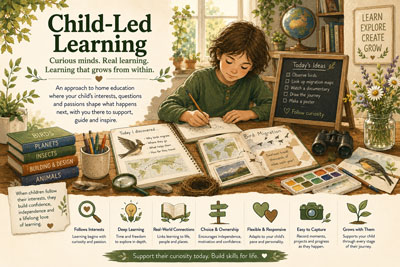
What is child-led learning?
Child-led learning means paying close attention to what a child is curious about and using those interests as a starting point for education. A child might become absorbed in insects, space, music, football, stories, machines, animals or baking, and that interest can lead into many different areas of learning.
It does not mean the child must make every decision or that parents step back completely. Adults still offer ideas, find resources, create opportunities, set sensible limits and help children develop skills they cannot yet manage alone.
The aim is to work with motivation rather than against it, while helping children become more confident, independent and engaged in their own learning.



Core features of child-led learning
What does child-led learning look like?
Child-led learning can look very different from day to day. A child may spend a morning designing a game, reading about dinosaurs, writing a story, caring for an animal or taking apart an old appliance to see how it works.
The parent’s role is often to notice the learning, help the child go deeper and introduce useful next steps. A strong interest can lead naturally into reading, writing, maths, science, research, creative work and practical skills.
How is child-led learning different from unschooling?
The two approaches overlap, but they are not always identical. Unschooling usually describes a broader philosophy where learning is woven into life and formal lessons are used sparingly or not at all.
Child-led learning can be used inside many different home education styles. A family might follow a curriculum for maths, use structured reading practice and still allow a child’s interests to guide projects, science, history or creative work.
In other words, child-led learning can be a complete approach, but it can also be one important part of an eclectic or structured home education.
Who does child-led learning suit?
Child-led learning can work well for children who have strong interests, learn in bursts or resist activities that feel disconnected from real meaning. It can also help children rebuild motivation after stressful school experiences.
It suits parents who are comfortable observing, adapting and sometimes letting a topic develop in an unexpected direction. The approach still benefits from gentle guidance, especially where a child needs help expanding beyond familiar interests.
- Children who learn deeply through strong interests
- Families who want learning to feel meaningful and personalised
- Children who struggle with rigid timetables or repetitive work
- Parents who enjoy following questions and learning alongside their child
- Families who want to combine freedom with supportive guidance
How to support child-led learning
Supporting child-led learning is more than waiting for a child to announce what they want to study. Children often need access to interesting materials, places, people and experiences before new interests can grow.
Parents can help by creating a rich environment, asking thoughtful questions and offering possibilities without turning every interest into an assignment.
- Notice recurring interests, questions and favourite activities
- Offer books, videos, tools, materials, trips and useful people
- Ask whether your child wants help taking an idea further
- Give enough time for deep play, practice and concentration
- Introduce related ideas without taking control of the interest
- Help break ambitious ideas into manageable steps
How to record child-led learning
Child-led learning can be difficult to remember because it often develops through conversations, hobbies, play, projects and spontaneous questions. Short records can reveal how much depth and progress sits behind an apparently ordinary day.
Useful records might include the original interest, resources used, questions asked, skills practised, projects completed and how the child’s understanding changed over time.
- Interests your child returned to and explored in depth
- Books, videos, websites, trips or conversations used
- Photos of projects, makes, experiments and practical work
- Writing, maths, research or creative skills used naturally
- Problems solved, decisions made and changes attempted
- Progress in confidence, independence and communication
Using Strew for child-led learning
Strew works well for child-led learning because it helps you capture education without interrupting it. You can quickly record a question, project, conversation, game, book, outing or practical skill while the experience is still fresh.
Over time, those small entries create a clear picture of your child’s interests and development. Strew can help organise them into learning areas and turn varied child-led activity into a useful home education report.
Child-Led Learning FAQs
What does child-led learning mean?
Child-led learning means allowing a child’s interests, questions and pace to influence what they learn and how they explore it, while adults provide support, resources and guidance.
Is child-led learning the same as unschooling?
They overlap, but they are not always the same. Child-led learning can be used within structured, eclectic or curriculum-based home education, while unschooling is usually a broader life-learning philosophy.
Does child-led learning mean children only do what they want?
No. Parents still provide boundaries, guidance and responsibilities. The child has meaningful input, but the adult remains responsible for creating a supportive and suitable education.
How do children learn core subjects through child-led learning?
Reading, writing, maths and science often appear naturally through projects, games, research, cooking, building, budgeting and everyday life. Families can also add direct teaching where it is helpful.
What if my child only has one interest?
One strong interest can connect to many skills and subjects. Parents can gently introduce related books, places, questions and projects while also creating opportunities for the child to encounter new ideas.
Is child-led learning suitable for younger children?
Yes. Younger children naturally learn through play, movement, imitation, stories, questions and practical activity. Adults can support this with rich experiences and age-appropriate guidance.
Can child-led learning work for teenagers?
Yes. Teenagers can take greater ownership of projects, courses, qualifications, work experience, creative goals and future plans, while parents continue to provide support and perspective.
Can I combine child-led learning with a curriculum?
Yes. Many families use a curriculum for some areas and child-led learning for others. You might keep regular maths and reading while allowing interests to guide projects, history, science and creativity.
How do I show evidence of child-led learning?
Evidence can include notes, photos, projects, reading, research, practical work, conversations, drawings, writing and records of the skills used while following an interest.
Can Strew help record child-led learning?
Yes. Strew helps you capture spontaneous learning, projects, questions, photos and progress, then organise those moments into clear home education records and reports.
Capture Child-Led Learning Without Interrupting It
Strew helps you record interests, questions, projects, conversations and everyday discoveries, then turn child-led learning into clear home education records and reports.