
Montessori Home Education
Montessori home education is a hands-on, child-centred approach built around independence, practical life skills, careful observation and learning through real materials. It helps children build confidence by giving them space to explore, practise and master skills at their own pace.
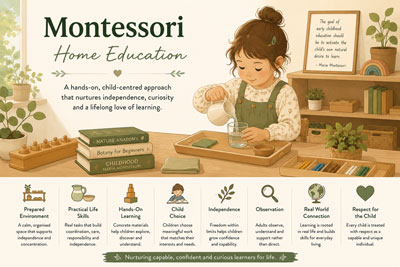
What is Montessori home education?
Montessori education was developed by Dr Maria Montessori. At its heart is the belief that children are naturally curious and capable, and that they learn best when they can actively engage with their environment rather than simply being told what to know.
In a home education setting, Montessori often means creating a calm, prepared space where children can choose meaningful activities, use hands-on materials, practise practical life skills and develop independence through real responsibility.
It is not just about beautiful wooden toys or perfect shelves. The real Montessori spirit is about respecting the child, noticing their development and offering the right support at the right time.
Core features of the Montessori approach
What does a Montessori home education day look like?
A Montessori-inspired day often includes a balance of child-led activity, practical tasks and calm focused work. A child might prepare their own snack, water plants, sort objects, practise counting with physical materials, read, paint, pour, measure, clean, build or explore a topic through real objects and books.
Rather than rushing from one adult-led lesson to another, Montessori encourages concentration and repetition. If a child is deeply engaged in an activity, that focus is usually protected rather than interrupted.
Who does Montessori suit?
Montessori can work well for families who value independence, calm routines, hands-on learning and practical life skills. It can be especially useful for younger children, but Montessori ideas can also support older children through project work, responsibility, research and self-directed study.
It suits parents who are willing to observe before stepping in. The adult’s role is not to control every moment, but to prepare the environment, offer useful materials and support the child’s growing independence.
- Children who enjoy hands-on, practical activities
- Families who want to build independence and responsibility
- Parents who prefer calm rhythms over rushed lessons
- Children who benefit from repetition and self-paced practice
- Home educators who want learning to connect with everyday life
How to record Montessori learning
Montessori learning can look simple from the outside, but it often contains a lot of development: coordination, concentration, order, language, maths, independence, problem-solving and confidence. Recording these moments helps you see the progress behind everyday activities.
Useful records might include practical life tasks, photos of activities, notes on new skills, interests your child returns to, materials used, problems solved and signs of increasing independence.
- Practical life activities such as pouring, cutting, cooking or cleaning
- Fine motor work, sorting, matching, counting or sequencing
- Photos of materials, makes, shelves or completed activities
- Moments of concentration, persistence or problem-solving
- New vocabulary, questions or observations
- Progress in independence, confidence and self-care
Using Strew for Montessori home education
Strew works well for Montessori families because it helps you capture the learning inside everyday activity. You can quickly record practical life tasks, hands-on maths, language work, nature observation, art, cooking, sorting, building or independent projects.
Over time, those small records show real development. This is especially useful if you want to create a home education report that explains your child’s progress clearly without making your home feel like a formal classroom.



Montessori Home Education FAQs
Is Montessori home education the same as child-led learning?
Montessori includes child choice and self-directed activity, but it is not completely unstructured. The adult prepares the environment, observes the child and offers purposeful materials that support development.
Do I need expensive Montessori materials?
No. Specialist materials can be useful, but Montessori at home does not have to be expensive. Practical life activities, real household tools, nature objects, books, trays, baskets and simple hands-on resources can all support Montessori-style learning.
What is a prepared environment?
A prepared environment is a space arranged so the child can act more independently. This might mean accessible shelves, child-sized tools, clear activity choices, calm storage and materials the child can use without constant adult help.
Is Montessori suitable for older children?
Yes. While many people associate Montessori with early years, older children can benefit from independence, responsibility, research, practical projects, real-world work, problem-solving and self-directed study.
How does Montessori teach maths?
Montessori maths usually starts with concrete materials and real experiences. Children handle, count, compare, group, measure and build understanding physically before moving toward more abstract written maths.
How does Montessori support reading and writing?
Montessori language work often includes rich conversation, sound games, practical writing, books, letter shapes, matching, storytelling and activities that build hand strength and coordination before formal writing becomes fluent.
Can I mix Montessori with other home education styles?
Yes. Many families combine Montessori with Charlotte Mason, unschooling, forest school, unit studies or structured lessons. You can use Montessori principles without following the method perfectly.
Is Montessori too rigid for home education?
It does not have to be. Some Montessori settings are very precise, but at home you can use the principles in a flexible way: independence, respect, hands-on learning, observation and practical life.
How do I show evidence of Montessori learning?
Evidence can include photos, activity notes, practical life records, maths work, language activities, art, projects, nature observations and notes on independence, concentration and problem-solving.
Can Strew help with Montessori home education records?
Yes. Strew helps you log Montessori-style activities, capture photos and notes, identify learning areas and turn everyday progress into clear home education records and reports.
Record Montessori Learning as It Naturally Happens
Strew helps you capture practical life skills, hands-on activities, independence, projects and everyday discoveries, then turn them into clear home education records and reports when you need them.