
Relaxed Home Education
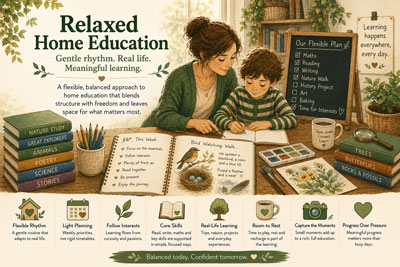
Relaxed home education is a flexible middle ground between a tightly structured timetable and fully child-led learning. Families usually keep a gentle rhythm, cover important skills and make plans, while leaving plenty of space for interests, real life, rest and changing needs.
What is relaxed home education?
Relaxed home education is an adaptable approach that uses some structure without allowing the plan to control family life. Parents may choose regular resources for maths, reading or writing, but the rest of the week can include projects, trips, outdoor learning, hobbies, groups and spontaneous interests.
It is sometimes called relaxed homeschooling. The word “relaxed” does not mean careless or inactive. It means the family focuses on meaningful progress rather than recreating a full school day at home.
A relaxed home educator might have clear goals for the month, a loose weekly rhythm and a small number of regular activities, while remaining willing to change the plan when a child needs more time, rest or a different approach.



Core features of relaxed home education
What does a relaxed home education day look like?
A relaxed day might begin with reading, maths or writing, followed by a long break, a nature walk, baking, a documentary, an art project or time spent following a current interest. Another day might be entirely taken up by a trip, home education group or practical project.
The family may have a plan, but it is treated as a guide rather than a strict timetable. If a child becomes deeply interested in something useful, there is usually room to stay with it rather than moving on simply because the clock says so.
How is relaxed home education different from unschooling?
Relaxed home education often includes more parent-planned learning than unschooling. A relaxed family might use regular lessons, workbooks or curriculum resources in some subjects, while keeping the wider week flexible.
Unschooling generally places more emphasis on learning emerging from life and the child’s interests, with little or no fixed curriculum. In practice, there is plenty of overlap, and families may move between the two approaches over time.
Relaxed home education is often a useful fit for parents who want confidence that key skills are being supported, without turning the home into a classroom.
Who does relaxed home education suit?
Relaxed home education can suit families who want some direction but find detailed schedules stressful or unrealistic. It can also work well for children who need predictability in small doses but resist long formal lessons.
It is especially useful when family life includes work, younger siblings, health needs, appointments, travel or changing energy levels. The approach can bend around real life while still supporting steady learning.
- Families who want structure without a rigid timetable
- Children who learn best through a mix of lessons and real experiences
- Parents who want clear priorities but freedom over the daily plan
- Children who need lower pressure or shorter learning sessions
- Families whose routines, health or commitments change from week to week
How to create a relaxed home education rhythm
A relaxed rhythm gives the week enough shape to reduce uncertainty without filling every hour. Instead of planning a school-style timetable, you might choose a few anchors and allow the rest of the learning to move around them.
It can help to decide which skills need regular practice, which activities happen weekly and which areas can be followed more freely.
- Choose two or three priorities for each day
- Use short lessons for skills that benefit from regular practice
- Keep some days open for groups, trips and outdoor learning
- Plan weekly goals rather than scheduling every hour
- Leave space for hobbies, projects and unexpected questions
- Adjust the rhythm when it stops working for your family
How to record relaxed home education
Relaxed home education includes both planned and informal learning, so keeping brief records can help you see the full picture. It is easy to remember the workbook lesson and forget the discussion, cooking, trip, project or practical skill that happened later.
Useful records might include lessons completed, books read, projects, conversations, outings, photos, interests followed and notes about growing confidence or independence.
- Regular lessons, resources and skills practised
- Books, audiobooks, documentaries and discussions
- Projects, hobbies, experiments and creative work
- Trips, groups, clubs and outdoor experiences
- Photos of practical learning and finished work
- Progress in confidence, independence and understanding
Using Strew for relaxed home education
Strew works well for relaxed home education because it can capture both the planned and unexpected parts of learning. You can record a maths lesson, a book, a long conversation, a project, an outing or a practical skill in the same place.
Over time, those small entries show that flexible learning can still be consistent and purposeful. Strew can help organise your records into learning areas and turn them into a clear home education report when needed.
Relaxed Home Education FAQs
What is relaxed home education?
Relaxed home education uses a flexible plan, gentle routines and a mixture of structured and informal learning. Families keep some direction without following a rigid school-style timetable.
Is relaxed home education the same as unschooling?
Not usually. Relaxed home educators often use more parent-planned lessons or resources, while unschooling tends to rely more fully on interests, everyday life and self-directed learning.
Does relaxed home education mean doing less?
Not necessarily. It means focusing on useful learning rather than filling a set number of hours. Children may still learn extensively through reading, projects, trips, practical life and conversation.
Do relaxed home educators use a curriculum?
Some do. Families might use curriculum resources for maths, literacy or exam preparation while taking a more flexible approach to other subjects.
How much planning does relaxed home education need?
Planning can be light. A weekly list of priorities, regular activities and available resources may be enough. The aim is to provide direction without making the plan difficult to maintain.
Is relaxed home education suitable for anxious children?
It can be. Lower pressure, shorter lessons and flexible pacing can help children rebuild confidence. Some children still benefit from gentle routines so they know what to expect.
Can relaxed home education prepare children for exams?
Yes. Families can become more structured around specific qualifications while keeping the rest of home education flexible. Exam preparation does not require every part of the week to become school-like.
How do I know whether my child is making progress?
Look at progress over time in skills, understanding, confidence, independence, communication and depth of interests. Keeping short records can make this development easier to notice.
How do I show evidence of relaxed home education?
Evidence can include lesson notes, reading, photos, projects, practical work, outings, conversations, written work and records of your child’s changing skills and understanding.
Can Strew help record relaxed home education?
Yes. Strew helps you capture structured lessons, spontaneous learning, projects, trips and progress, then organise those moments into clear home education records and reports.
Keep Flexible Learning Clear and Easy to Remember
Strew helps you record lessons, interests, projects, trips and everyday discoveries, then turn relaxed home education into clear records and reports without adding lots of admin.