
Structured Home Schooling
Structured home schooling is a planned, curriculum-led approach to home education. Families often use timetables, regular lessons, workbooks, online programmes or subject plans, while still keeping the flexibility to adapt learning around the child.
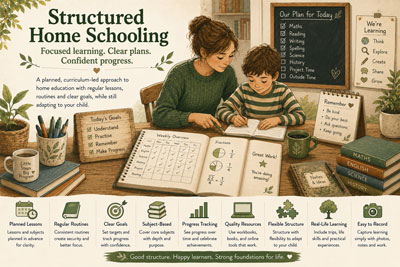
What is structured home schooling?
Structured home schooling is an approach where parents plan learning in advance and organise it into regular lessons, subjects or study periods. It is sometimes described as traditional homeschooling or school-at-home, although many families use structure without trying to copy school exactly.
A structured approach might include a maths curriculum, reading practice, writing tasks, science activities, history lessons and weekly goals. Some families follow the National Curriculum closely, while others use their own sequence of subjects and resources.
The main feature is predictability. Children usually know what they are expected to work on, and parents have a clearer view of what has been covered and what comes next.



Core features of structured home schooling
What does a structured home education day look like?
A structured day might begin with maths and reading, followed by writing, science or history. Some families use a school-style timetable, while others prefer a short morning block and leave afternoons free for projects, outdoor learning, clubs or trips.
Lessons can still be short, practical and personalised. Structure simply gives the day a clear shape; it does not require children to sit at a desk from nine until three.
Who does structured home schooling suit?
Structured home schooling can suit children who feel more secure when they know what is happening next. It can also help parents who prefer clear plans, regular progress and confidence that important subjects are being covered.
The approach can be particularly useful when preparing for exams, supporting specific learning goals or helping a child who finds open-ended choices overwhelming. The structure should still be adjusted if it creates unnecessary stress or resistance.
- Children who benefit from routine and predictability
- Families who want clear subject coverage and progression
- Parents who prefer planning lessons in advance
- Older children preparing for exams or qualifications
- Children who need focused support in particular subjects
How much structure do home educators need?
Structure exists on a spectrum. One family might use a detailed weekly timetable, while another simply plans three priorities each morning. Both can be structured approaches if learning is organised intentionally.
It is often better to begin with less structure and add more where it genuinely helps. A plan should support family life, not make everyone feel that they have failed whenever the day changes.
- A consistent start time or morning routine
- A weekly checklist rather than an hourly timetable
- Regular maths and literacy alongside flexible topic work
- Planned lessons on some days and trips or groups on others
- Clear goals with freedom over how and when they are completed
How to record structured home education
Structured home schooling can be straightforward to record because much of the learning is already organised into subjects, lessons and resources. However, it is useful to record progress and understanding rather than simply listing pages completed.
Good records might include lesson notes, work samples, books read, curriculum topics, photos, test results, project work and short observations about what your child understood or found difficult.
- Subjects, lessons and curriculum topics covered
- Workbooks, online courses, books and resources used
- Photos or samples of written and practical work
- Progress in reading, writing, maths and other core skills
- Areas where your child needed support or extra practice
- Projects, trips and informal learning alongside formal lessons
Using Strew for structured home schooling
Strew helps structured home educators keep lesson records, resources, photos and progress notes together. You can record formal lessons alongside projects, trips, practical skills and everyday learning, giving you a fuller picture than a simple checklist of completed work.
Over time, those entries can help with planning, identifying progress and creating a clear home education report without having to reconstruct months of learning from memory.
Structured Home Schooling FAQs
What is structured home schooling?
Structured home schooling is a planned approach where learning is organised into regular lessons, subjects, routines or curriculum goals. Families can still adapt the plan to suit the child.
Is structured home schooling the same as school at home?
It can be, but it does not have to be. Some families closely recreate a school timetable, while others use a much lighter structure with short lessons and flexible afternoons.
Do home educators have to follow the National Curriculum?
Home educating families in the UK are generally not required to follow the National Curriculum. Some families use it as a guide, while others choose different curricula or create their own plans.
How many hours should structured home education take?
There is no single correct number of hours. One-to-one learning can often be completed more efficiently than classroom teaching, and education can also include reading, projects, trips, clubs and practical life.
Do I need to buy a full homeschool curriculum?
No. A complete curriculum can save planning time, but many families combine individual maths, literacy and subject resources or build a simple plan using books, websites, projects and local opportunities.
Can structured learning still be child-centred?
Yes. Parents can adapt pace, lesson length, resources and topics around the child’s needs and interests. Structure and personalisation are not opposites.
What if my child resists formal lessons?
Consider shortening lessons, changing the resource, adding practical activities or reducing the amount expected at one time. Resistance can be useful information that the current method needs adjusting.
Can I combine structured home schooling with other approaches?
Yes. Many families combine structured maths and literacy with unit studies, project-based learning, Charlotte Mason, Forest School, unschooling or other child-led activities.
How do I show evidence of structured home education?
Evidence can include lesson records, completed work, reading lists, progress notes, curriculum topics, photos, projects, practical work and examples of growing understanding.
Can Strew help record structured home schooling?
Yes. Strew helps you record lessons, resources, progress, photos and informal learning, then organise everything into clear home education records and reports.
Keep Structured Learning Clear Without Creating More Admin
Strew helps you record lessons, resources, progress, projects and everyday learning, then turn your structured home education into clear records and reports.