
Unit Studies in Home Education
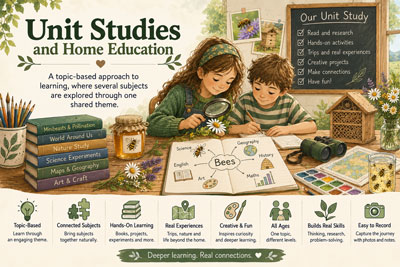
Unit studies are a topic-based approach to home education where several subjects are explored through one shared theme. A study of space, Ancient Egypt, oceans or bees might bring together reading, writing, science, maths, history, geography, art and practical activities.
What are unit studies?
Unit studies organise learning around a topic rather than treating every subject as a separate lesson. The family chooses a theme and explores it from several different angles, often using books, videos, experiments, trips, writing, art, maps and hands-on projects.
For example, a unit study about rivers might include learning how the water cycle works, finding major rivers on a map, reading stories set near rivers, measuring water flow, studying local wildlife and making a model landscape.
This makes learning feel connected. Instead of moving between unrelated tasks, children can build a deeper understanding of one subject while practising a wide range of skills.
Core features of unit studies
What does a unit study look like?
A unit study might last a single afternoon, several weeks or an entire term. Some families plan the topic carefully in advance, while others begin with a child’s interest and add activities as the study develops.
Children of different ages can often explore the same theme at different levels. A younger child might draw pictures and listen to stories, while an older child researches, writes, measures, compares sources or creates a detailed project.
Who do unit studies suit?
Unit studies can suit children who become deeply interested in particular topics and prefer connected learning over a collection of separate lessons. They can be especially effective for children who enjoy stories, projects, experiments, drawing, making or researching.
They are also useful for families home educating more than one child, because everyone can share the same broad topic while working at their own level.
- Children who enjoy exploring one interest in depth
- Families who want subjects to feel connected and meaningful
- Parents teaching children of different ages together
- Children who learn well through books, projects and hands-on activities
- Home educators who want structure without using a rigid subject timetable
How to plan a unit study
You do not need to cover every subject in every unit. Start with a topic your child is interested in, choose a few useful resources and build outwards from the questions that naturally appear.
A simple unit study can include one main book, a documentary, a practical activity, a local trip and a final project. More detailed studies might include a weekly plan, reading list, experiments, notebook work and several connected activities.
- Choose a broad topic or question
- Find a few good books, videos or other resources
- List natural links to science, history, geography, maths or language
- Add a practical activity, project or trip
- Leave room to follow unexpected questions and interests
- Finish with a conversation, presentation, model, poster or reflection
How to record learning from unit studies
Unit studies often produce a wide range of learning, but it can become difficult to remember which skills and subjects were covered. Keeping short notes as you go makes the depth of the study much easier to see.
Useful evidence might include reading, discussions, photos, drawings, written work, maps, calculations, experiments, trips and finished projects.
- The topic and the questions your child explored
- Books, videos, websites, museums or people used as resources
- Photos of activities, experiments and finished projects
- Writing, sketches, maps, diagrams and calculations
- New vocabulary, facts, skills and connections discovered
- A short reflection on what interested your child most



Using Strew for unit studies
Strew works well for unit studies because it helps you capture all the different learning connected to one theme. You can record books, discussions, experiments, writing, trips, art and practical projects without needing to create a separate system for every subject.
Over time, those entries become a clear record of what your child explored and how their understanding developed. Strew can also help turn that varied activity into a useful home education report.
Unit Studies FAQs
What is a unit study in home education?
A unit study is a topic-based approach where several subjects are explored through one shared theme. For example, a study of oceans might include science, geography, maths, reading, writing and art.
How long should a unit study last?
There is no fixed length. A unit study might last one day, a few weeks or several months. It can continue for as long as the topic remains useful and interesting to your child.
Do unit studies cover every school subject?
They can cover many subjects, but they do not need to cover everything. It is often better to use the natural subject connections rather than forcing every area into the same topic.
Are unit studies child-led?
They can be. Some studies begin with a child’s strong interest, while others are suggested or planned by the parent. Many families use a mixture of both.
Can children of different ages do the same unit study?
Yes. Children can explore the same topic at different levels. Younger children might use stories, pictures and simple activities, while older children complete deeper reading, writing or research.
Do I need to buy a unit study curriculum?
No. Ready-made unit studies can save planning time, but you can create your own using library books, videos, local trips, simple activities and your child’s questions.
What are some good unit study topics?
Popular topics include space, dinosaurs, oceans, weather, transport, Ancient Egypt, insects, farms, the human body, local history, countries, artists, inventors and favourite books.
Can unit studies be combined with structured lessons?
Yes. Many families use unit studies for science, history or geography while keeping separate structured lessons for maths, reading or other areas where regular practice is useful.
How do I show evidence of learning from unit studies?
Evidence can include notes, photos, reading lists, maps, diagrams, written work, experiments, models, presentations, trip records and summaries of what your child understood.
Can Strew help record unit studies?
Yes. Strew helps you capture the books, projects, activities, photos and learning areas connected to each unit, then organise them into clear home education records and reports.
Capture Every Part of a Unit Study
Strew helps you record books, projects, experiments, trips, writing and practical activities, then turn connected topic-based learning into clear home education records and reports.