
Worldschooling Home Education
Worldschooling is a real-world approach to home education where travel, places, culture, nature, community and everyday experiences become part of the learning journey. It can mean long-term travel, local adventures or simply using the wider world as your classroom.
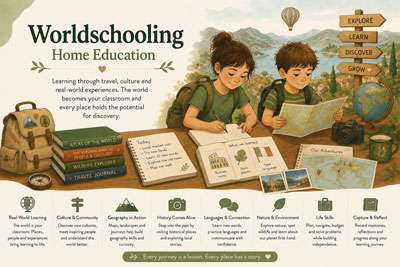
What is worldschooling?
Worldschooling is a style of home education that uses the world itself as a source of learning. Children learn through travel, local places, museums, nature, languages, food, history, people, landscapes, transport, money, maps and lived experience.
Some worldschooling families travel full-time. Others take regular trips, explore their local area, visit heritage sites, spend time outdoors or build learning around the places and communities around them.
At its best, worldschooling helps children connect knowledge to real life. Geography is not just a map, history is not just a date, and culture is not just a paragraph in a textbook.
Core features of worldschooling



What does worldschooling look like?
A worldschooling day might involve visiting a castle, comparing currencies, reading signs in another language, planning a train route, sketching a landmark, trying local food, learning about tides, or talking to someone with a different life experience.
You do not need to be constantly travelling for worldschooling to work. A local beach, woodland, farm, town centre, museum, market, river, library, workshop or historical site can all become rich learning spaces.
Who does worldschooling suit?
Worldschooling can suit families who want learning to feel active, practical and connected to real places. It can be a strong fit for children who love travel, nature, history, maps, animals, languages, food, transport, people or outdoor discovery.
It also suits families who prefer learning through experience rather than sitting at a desk for most of the day. The main challenge is making sure the learning is noticed, reflected on and recorded, rather than simply rushing from one experience to the next.
- Families who travel or take regular local trips
- Children who learn best through experience and movement
- Parents who want education to connect with real places and people
- Families interested in culture, geography, history and nature
- Home educators who want rich evidence from everyday adventures
How to record worldschooling learning
Worldschooling can produce excellent evidence of learning, but it is easy to forget the detail if you only keep photos. A short note about what your child noticed, asked, compared or understood can make the learning much clearer.
Useful records might include trips, places visited, maps used, new vocabulary, conversations, sketches, photos, tickets, nature observations, practical planning and reflections after the experience.
- Places visited and what your child learned there
- Photos, sketches, tickets, maps or leaflets
- Questions asked before, during or after a trip
- Practical skills such as planning routes, budgeting or reading timetables
- Nature, geography, history, language or cultural observations
- Follow-up learning such as books, videos, writing, projects or discussions
Using Strew for worldschooling
Strew works well for worldschooling because it helps you turn trips, local adventures and everyday experiences into clear learning records. You can quickly log a museum visit, woodland walk, journey, beach day, map-reading task, cultural experience or practical life skill.
Over time, those records show how much learning is happening across geography, history, science, language, culture, maths, independence and communication. This is especially useful when creating a home education report.
Worldschooling FAQs
What does worldschooling mean?
Worldschooling means using the world as part of your child’s education. It can involve travel, local trips, culture, nature, community, history, geography and practical real-life experiences.
Do you have to travel full-time to worldschool?
No. Some families travel full-time, but many use local trips, day visits, outdoor learning, community experiences and occasional travel as part of a worldschooling approach.
Is worldschooling legal in the UK?
Home education is legal in the UK, and families do not have to follow the National Curriculum. If you use worldschooling, it is helpful to keep records showing that your child is receiving a suitable education through those experiences.
How do children learn core subjects through worldschooling?
Maths, reading, writing, science, geography and history can all appear naturally through travel and real-world experiences. Families may also add books, apps, writing, projects or structured lessons where useful.
Can worldschooling work without much money?
Yes. Worldschooling does not have to mean expensive international travel. Local walks, museums, libraries, markets, historical sites, nature reserves, community groups and public transport can all support rich learning.
Is worldschooling suitable for younger children?
Yes. Younger children often learn well through places, people, movement, nature, sensory experiences and practical life. Keep trips manageable and build in time to rest and reflect.
Can older children use worldschooling?
Yes. Older children can use worldschooling for geography, languages, history, volunteering, research, photography, writing, budgeting, travel planning, environmental study and independent projects.
How do I show evidence of worldschooling?
Evidence can include photos, notes, maps, tickets, sketches, journals, writing, projects, route planning, conversations, nature observations and summaries of what your child learned from each experience.
Can worldschooling be mixed with other home education styles?
Yes. Worldschooling works well with unschooling, Charlotte Mason, project-based learning, unit studies, forest school, Montessori or structured lessons.
Can Strew help record worldschooling?
Yes. Strew helps you capture trips, experiences, photos, notes, questions and learning areas, then turn them into clear home education records and reports.
Turn Real-World Experiences Into Clear Learning Records
Strew helps you capture trips, places, culture, nature, practical skills and everyday discoveries, then turn worldschooling into clear home education records and reports.