
If you’re exploring education outside school, you may have come across EOTAS, which stands for Education Otherwise Than At School. Although it can involve learning at home, it is different from parents choosing to home educate. Here’s what the term means and how it relates to home education.
Understanding EOTAS in Home Education
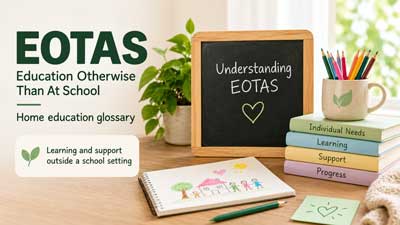
In England’s special educational needs system, Education Otherwise Than At School (EOTAS) describes arrangements for a child or young person’s special educational provision to be delivered outside a school or college because providing it in that setting would be inappropriate.
Depending on the child’s assessed needs, an EOTAS package might include:
- Individual tuition at home or another suitable location
- Specialist teaching and learning support
- Therapies that form part of the child’s special educational provision
- Education delivered through a combination of suitable providers
EOTAS is arranged by the local authority. In England, it is commonly discussed in connection with an Education, Health and Care Plan (EHCP), which sets out the child’s needs and the provision required.
- It is based on individual needs: the arrangements should reflect the support the child requires.
- It is arranged and funded by the local authority: parents do not simply take over responsibility for providing the agreed package.
- It can happen in different places: EOTAS does not necessarily mean that all learning takes place at home.
The key distinction is between EOTAS and elective home education. With elective home education, parents choose to arrange their child’s education themselves. With an agreed EOTAS package, the local authority remains responsible for securing the special educational provision specified in the EHCP.
A child with an EHCP does not automatically qualify for EOTAS. In England, the local authority must be satisfied that it would be inappropriate for the required special educational provision to be made in a school or other relevant educational setting.
For example, a child might need an individually tailored combination of tuition and specialist support outside school. However, difficulties at one particular school do not necessarily mean EOTAS will be agreed if another school could appropriately provide the support required.
The legal framework described here applies to England. Terminology and arrangements differ elsewhere in the UK, so it is important to check the rules for your nation. For more context, see our guide to Home Education Law in the UK / England and section 61 of the Children and Families Act 2014.
In practice, an EOTAS package should clearly describe the support to be delivered. In England, the special educational provision belongs in section F of the EHCP. Families can discuss the arrangements with their local authority and seek independent SEND advice if there is disagreement about what their child needs.
Keeping simple records of activities, support and progress can help families contribute to reviews and discussions. Tools like Strew’s home education report page can help organise those observations, alongside the formal records kept by education providers.
EOTAS (Education Otherwise Than At School) is therefore an arrangement for education and support outside a school setting. In England’s SEND system, it has a specific legal basis and should not be confused with a family choosing elective home education.
What does EOTAS mean to you?
If you have got something to add to our EOTAS page, please do let us know.