
No. The Children’s Wellbeing and Schools Act 2026 does not abolish home education or require children to learn in a traditional classroom style. Families in England and Wales can still use flexible, child-led approaches, including practical activities, creative projects and everyday experiences, provided the education is suitable.
The changes introduce greater local authority oversight, but they do not mean home education must suddenly look like school.
What is changing for home-educating families?
The Children’s Wellbeing and Schools Act received Royal Assent on 29 April 2026.
Its home education provisions include:
- New Children Not in School registers, with information requirements for parents.
- Additional local authority powers to assess whether children are receiving a suitable education.
- Stronger safeguarding measures, including consent requirements for certain children with child protection concerns.
- Changes to the School Attendance Order process.
These measures are intended to improve safeguarding and help local authorities identify children who may not be receiving suitable education.
Not all provisions came into force immediately. The detailed requirements and implementation timetable differ between England and Wales.
For more information, see our guide to UK home education law or the Welsh Government’s explanation of the 2026 Act.
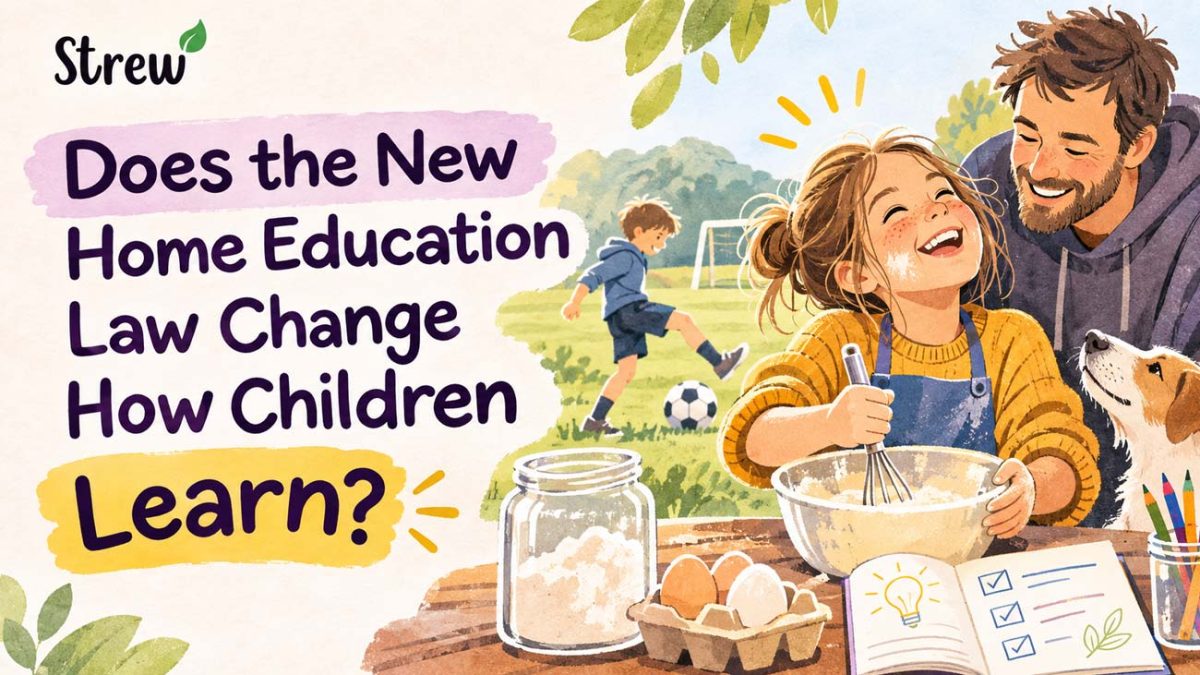
Can children still learn through cooking, football and creative activities?
Absolutely. Home education does not have to follow a school timetable or the National Curriculum.
A child’s learning might include:
- Football: Physical development, teamwork, coordination, strategy and resilience.
- Cooking: Measuring ingredients, working with fractions, reading instructions, nutrition and practical independence.
- Creative projects: Art, design, problem-solving, experimentation and self-expression.
- Outdoor activities: Exploring nature, observing wildlife, understanding the environment and developing practical skills.
A family might spend a substantial part of a day exploring one interest, rather than dividing learning into fixed school subjects.
That flexibility remains possible under the new legislation.
However, not every activity automatically demonstrates a suitable education. What matters is the wider educational provision, including whether it meets the child’s age, ability, aptitude and any special educational needs.
Why recording everyday learning can be helpful
When learning takes place through everyday experiences, progress is not always obvious from worksheets or completed textbooks.
Keeping a simple learning record can help parents explain what their child has been doing and how their knowledge, understanding and skills are developing.
For example, rather than recording only “made a cake”, you might note:
“Followed a recipe independently, measured ingredients, doubled quantities and discussed how yeast makes dough rise.”
That short description makes the educational value much clearer.
Photographs, activity notes, projects and conversations can all contribute to useful evidence of learning.
You do not need to document every moment or turn family life into paperwork. A few meaningful notes, recorded regularly, can provide a useful picture of progress.
Will parents have to write a home education report?
There is no universal requirement for every home-educating family in England and Wales to submit a standard annual report.
Local authorities can make enquiries about whether a child is receiving suitable education, and the new legislation creates additional information requirements once the relevant provisions take effect.
A clear learning record can make responding to enquiries easier, but an app-generated report is not automatically a substitute for any information the local authority is legally entitled to request.
Families can also create reports for their own records, to reflect on progress or to prepare for future educational transitions.
Using Strew to keep track of learning
Strew helps parents record activities, photographs and learning outcomes as they happen. Its AI assistant can suggest possible learning connections, which parents can review, and recorded activities can be organised into a home education report without having to reconstruct the entire year from scattered notes.
Video transcript
No, the new changes do not mean that home education isn’t an option.
The law is changing. They’re changing it essentially to try and reduce some of the risks associated with the freedom around home education, and the lack of responsibility local authorities have been having, in my opinion, over observation of children who are home educated.
I think we can all agree that the safety of children has to be paramount. However, human rights also need to be respected.
Home education will still look the same.
They could spend 40% of their day practising their football skills, 20% doing maths, 10% doing English. They could spend a lot of their time doing creative work, spend all day learning to cook and include that as part of their home education plan.
And we get this quite a lot because a lot of people say, “Well, that’s not an education.”
Just because it’s not sitting down in front of a desk with a notepad and pen or a worksheet, and you’re not filling in questions, doesn’t mean there aren’t valuable learning opportunities within things such as that.
So it is important to record milestones in learning and the progress they’ve made.
Certain home education apps come in handy. There are different methods parents use to record their children’s learning.
I’ve seen some parents use things like Instagram. They just take a couple of pictures and make a note. It’s a fantastically simple way of doing it. Nothing wrong with that.
However, I’ve been there, and I know that when it comes to the end of the year and you have to make a report, you’re going through that Instagram, looking to make notes on what you’ve been doing and trying to formulate that into something that makes sense.
That’s where Strew comes in.
You can quite quickly and easily enter the activities that the child has done, enter their learning outcomes and what they’ve achieved.
It’s also got an AI assistant tool in it, which will tell you, based on what you’ve inputted, what else they may have achieved that you hadn’t considered.
At the end of the year, you can generate a report with all of that information on.
It’s not something that you would directly send as a replacement for everything you might provide to the local authority. It kind of strengthens it and goes alongside it for that responsibility, but it just makes life so much easier.
That is part of the beauty of watching a child progress who’s home educated but doesn’t have that typical sit-down-in-front-of-a-workbook education.





Leave a Reply