
Home-educated children are not automatically disadvantaged compared with schoolchildren.
Home education can offer more freedom to explore personal interests, develop individual strengths and learn at a suitable pace. However, the quality of education, available opportunities and support a child receives matter far more than whether they learn at home or in school.
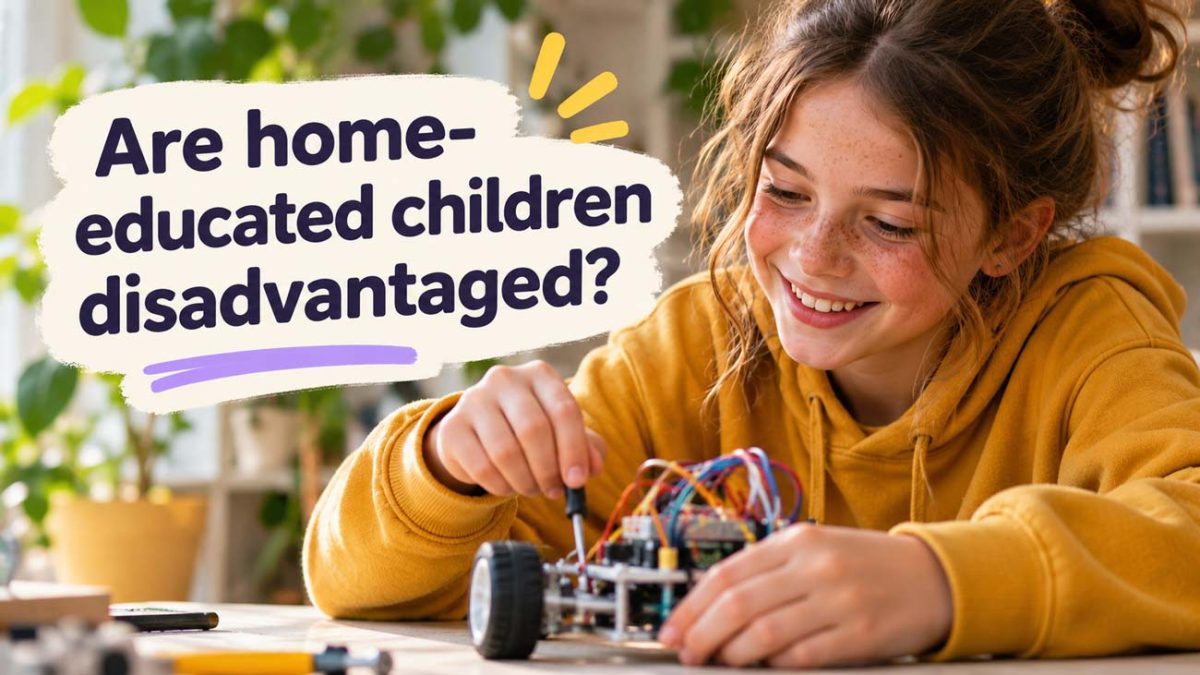
Can Home-Educated Children Be Successful?
One common misconception about home education is that children who don’t attend school must be missing out on opportunities.
But history offers some interesting examples of successful people who learned outside conventional classrooms.
Thomas Edison, the inventor, attended school for only a few months before being taught at home by his mother. He spent much of his childhood reading, experimenting and exploring scientific ideas.
Agatha Christie, one of the world’s most successful novelists, was initially educated at home. She taught herself to read at an early age and developed a love of stories and imagination.
Emma Watson, who played Hermione Granger in the Harry Potter films, received private tutoring while working on set, although she also attended conventional school.
These examples don’t prove that home education produces more successful people. They do, however, challenge the assumption that attending a conventional school is the only route to achievement.
Why Following a Child’s Interests Matters
One potential advantage of home education is the freedom to dedicate more time to subjects and activities that genuinely interest a child.
Imagine a child who loves engineering. Rather than spending most of their day following a fixed timetable, they might have more opportunities to:
- Build models and experiment with mechanisms.
- Explore how machines and electronics work.
- Develop practical problem-solving skills.
- Read about engineering discoveries and inventions.
- Spend extended periods working on a project they enjoy.
The same applies to music, sport, writing, art, coding or almost any other interest.
Developing real expertise takes time, practice and persistence. Home education can create space for that sustained engagement.
This is the principle behind child-led learning, where children’s interests help shape their education while parents continue to provide guidance, resources and opportunities to develop broader skills.
Does School Limit Children’s Opportunities?
Not necessarily.
Schools can provide valuable experiences, including specialist teaching, friendships, teamwork, extracurricular activities and access to facilities that may be difficult to recreate independently.
However, school timetables also divide children’s attention between many subjects, sometimes leaving less time for individual passions.
Home education offers a different balance. Families may have greater flexibility over how learning time is spent, although parents must still ensure children receive a suitable education.
In England, home-educated children do not have to follow the National Curriculum, but they must receive an efficient, full-time education suitable for their age, ability, aptitude and any special educational needs.
Source: GOV.UK, Educating your child at home
Are Home-Educated Children More or Less Likely to Succeed?
There isn’t enough reliable UK evidence to conclude that home-educated children generally achieve better or worse educational outcomes than schoolchildren.
Success also means different things to different families. Academic qualifications matter, but so can independence, confidence, practical abilities, relationships and finding work that feels meaningful.
Home education can provide time for children to discover what they enjoy and develop their strengths. It also requires commitment, resources and opportunities for social connection and broader learning.
The important question isn’t simply whether a child attends school.
It’s whether their education helps them develop the knowledge, skills and confidence to pursue a fulfilling future.
Using Strew to Follow Your Child’s Interests
Strew helps home-educating families record everyday activities, projects and interests, making it easier to see how children’s learning develops over time. You can capture practical achievements alongside more traditional learning and use those records to produce a home education report.
Video transcript
What do you mean when you say home-educated children are disadvantaged compared to schoolchildren?
I think from an outside perspective, a lot of people see home education and think of children who are limited in their education.
However, what I would do is challenge that with some prime examples of home-educated people who have gone on to achieve amazing things.
Thomas Edison was home educated. Agatha Christie was home educated. Emma Watson was home educated while she was on the set of Harry Potter.
Think of it this way. Even some of the greatest minds, or the greatest sportspeople, have their ability, their passion, their drive and their success because they maintain consistency in something that they enjoy.
And when you’re in a school environment and you’re learning things that you don’t particularly enjoy, in a way or manner that you don’t engage with, you subsequently have less time to spend on the things that you enjoy.
Put this into perspective as an adult. We can all relate to this story.
You leave school, you go to college, you may or may not go to university, and you follow a path of things that people have said you should get into because they’re potentially things that can create job opportunities.
Before you know it, five years down the line, you’re still in that job. Something that you aren’t passionate about.
That job is paying the bills, and all of a sudden, those passions and interests you had as a child are no longer accessible to you.
Because, quite simply, maybe you don’t have the time or the energy.
Because to be great at something, even when you enjoy it, you have to spend time doing it.






Leave a Reply