
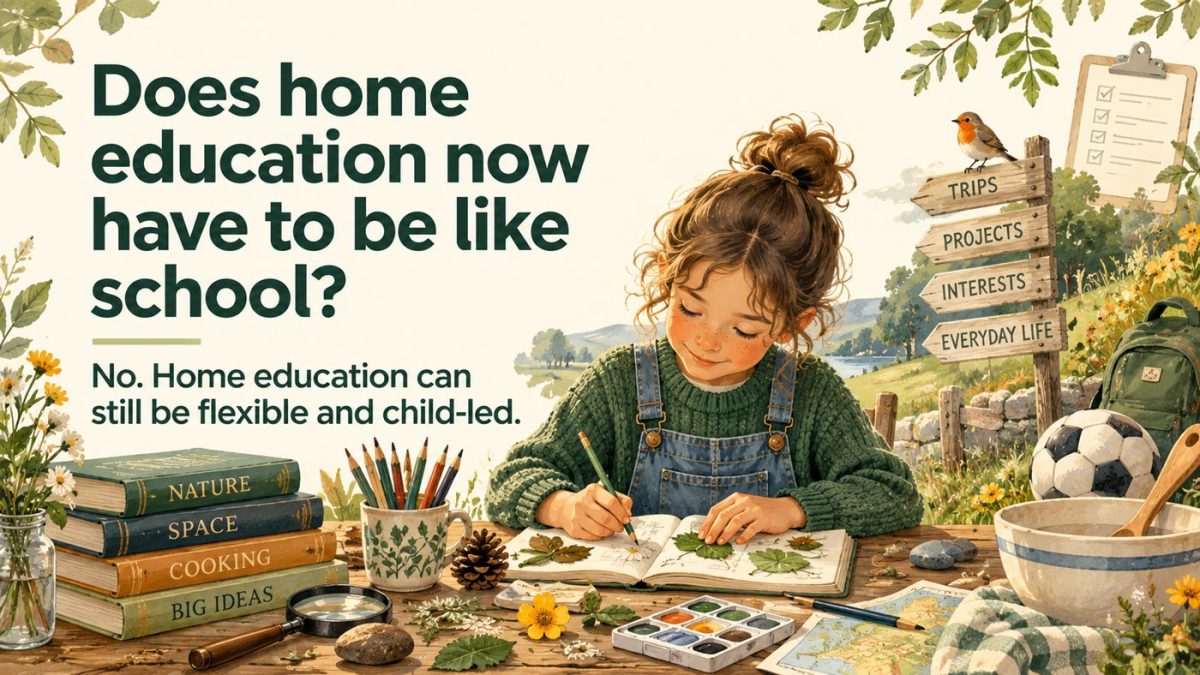
No. The Children’s Wellbeing and Schools Act 2026 does not require home-educating families in England or Wales to recreate school at home or follow the National Curriculum. Home education remains a legal option, and parents can continue choosing an approach that suits their child’s needs. The Act introduces additional registration and oversight measures, rather than a requirement to teach like a school.
Do home educators have to follow the National Curriculum?
No. In England, the government explicitly states that home-educating parents do not have to follow the National Curriculum.
That means you don’t need to:
- Follow a school timetable or traditional school hours.
- Teach subjects in the same order as a school.
- Use formal lessons or worksheets for every activity.
- Recreate a classroom environment at home.
Home education can still take many forms, including structured lessons, child-led learning, projects, reading, educational trips, practical skills and everyday experiences.
The important distinction is that you have a legal responsibility to provide a suitable, efficient, full-time education, taking account of your child’s age, ability, aptitude and any special educational needs.
Full-time education does not necessarily mean following school hours.
Source: GOV.UK: Educating your child at home
What does the Children’s Wellbeing and Schools Act actually change?
The Act received Royal Assent on 8 May 2026.
Rather than changing home education into school-based learning, its children-not-in-school measures introduce additional responsibilities and oversight.
These include:
- Children Not in School registers: Local authorities in England and Wales will be required to maintain registers of eligible children who are not attending school, including home-educated children.
- Information requirements: Parents of children covered by the registration measures will have responsibilities to provide specified information.
- Local authority support: The measures introduce a duty for local authorities to provide support to eligible home-educating families who request it.
- Additional safeguards: Some children in particular circumstances, including specified child protection situations, will require local authority consent before being removed from school for home education.
The relevant measures are subject to commencement arrangements, with further regulations and guidance shaping their practical implementation.
You can read the legislation in the Children’s Wellbeing and Schools Act 2026.
Can you still follow a child-led approach?
Yes. The Act does not introduce a requirement for home educators to adopt school-style teaching.
For example, a child fascinated by nature might learn through gardening, observing wildlife, reading books, visiting nature reserves and documenting what they discover.
Another child might prefer structured maths lessons, online courses and organised activities.
Both approaches can form part of a suitable home education.
However, freedom to choose an educational approach does not remove the responsibility to provide an appropriate education. Local authorities retain powers to investigate concerns about suitability, and the new legislation strengthens aspects of their oversight.
What should home-educating parents do now?
You do not need to change your educational approach simply to make it resemble school.
It is sensible, however, to keep a clear picture of the education your child is receiving, especially as registration and information requirements are introduced.
Consider keeping simple notes about activities, books, projects, interests, skills developed and progress over time.
These can help explain your child’s education without turning their learning into a school-style checklist.
Using Strew
Strew helps you record your child’s everyday learning, from projects and books to trips and practical activities. You can build a record over time and turn it into a home education report when needed, without changing the way your child learns.
Video transcript
Home educators, does the new Act mean that you need to recreate school at home?
No.
One of the biggest concerns we’re hearing from home educators is whether the Children’s Wellbeing and Schools Act means that home education is about to be more like school.
The good news is that the new measures do not change home education from being an option.
And it does not mean you have to sit your child down in a school-like manner, following the National Curriculum.
Home education can still be built around your child’s interests, needs, abilities and circumstances.
That could be structured lessons. It could be project-based learning. It could be learning through everyday activities, interests, trips, books, sports, practical skills and much more.
But what is changing?
What is changing is the level of information and oversight around children who are not in school.
So the message isn’t that home education has to be more like school. It’s that home education is still an option, but there might be more oversight.
And the practical details will depend on regulations and guidance as the new system is implemented.
Follow Strew for more simple explanations of these changes, and download the Strew app today to start recording your child’s learning.
Available on the iOS App Store or Google Play Store.



Leave a Reply