
Home education can include planned lessons, child-led projects, practical activities and learning through everyday life. It does not have to recreate a classroom at home. Parents arrange their child’s education and support their learning, choosing an approach that meets their needs.
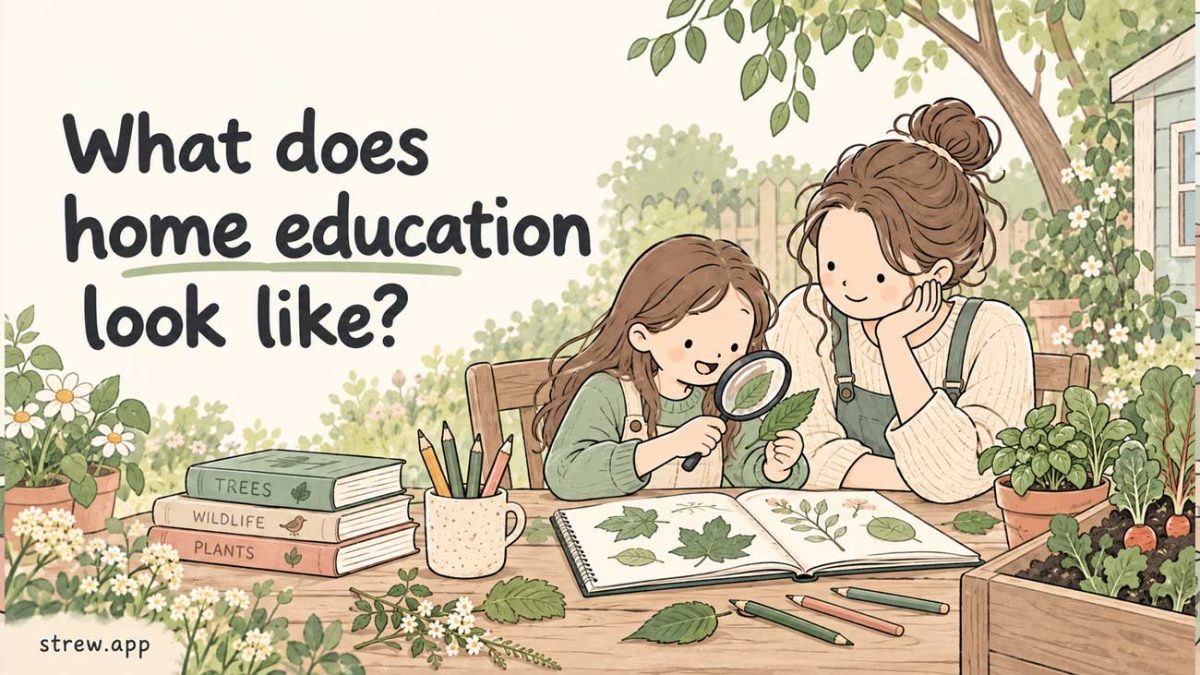
Does home education have to follow a curriculum?
In England, home-educating families do not have to follow the National Curriculum. In Wales, families are also free to choose their approach without following the Curriculum for Wales. A curriculum can provide a useful framework, but it is not the only way to organise learning.
That flexibility comes with responsibility. In England and Wales, parents must ensure that a child of compulsory school age receives an efficient, full-time education suited to their age, ability, aptitude and any special educational needs. Parents already hold this responsibility, including when their child attends school; home education changes how they fulfil it. (Source: Departmental guidance for parents.)
The legal points here concern England and Wales. Check the relevant national guidance when making arrangements elsewhere in the UK.
Three ways home education can work
There is no single home education timetable. The video describes three broad approaches:
- Structured learning: planned lessons, resources and subject time, perhaps using workbooks, courses or a curriculum.
- A mixed approach: some planned learning alongside projects, outings and time to explore interests.
- Child-led learning or unschooling: the child’s interests and questions help guide learning, with parents providing support, resources and opportunities.
Child-led learning still involves an active parent. You might help your child find information, introduce a new experience or notice when they need more support. Whichever approach you choose, you remain responsible for ensuring that the education is suitable.
You can explore these options in our guide to different home education styles. You do not need to choose a permanent label before you begin.
What can learning look like day to day?
Worksheets and reading can be part of home education, but useful learning also happens away from a desk.
For example:
- Shopping: comparing prices, estimating a total or working out change.
- A cinema visit: discussing a character’s choices, retelling the story or comparing the film with a book.
- Outdoor activities: identifying plants, measuring distances or practising physical skills.
The useful question is what your child explored, understood or practised. A trip creates opportunities for learning, but its educational value depends on what happens during and around it.
How can you tell whether your approach is working?
Start with your child’s needs and interests. What engages them? What can they do independently? Where do they need help?
Revisit those questions as you go. Progress might mean explaining an idea more clearly, reading something they previously found difficult or applying a skill in a new situation.
Brief notes, photographs and examples of work can help you remember those changes. You might record what happened, what your child did and anything you want to revisit. Our guide to what counts as evidence of learning gives more examples.
Learning still happens when it is not recorded. The purpose of keeping a record is to make reflection and later summaries easier.
Using Strew
Strew’s learning log lets you keep activity notes and photos together, whether your days involve planned lessons or spontaneous projects. Those records can help you review learning over time and prepare a home education report when useful.
Video transcript
What is home education, and why are so many parents choosing to home educate?
Home education, quite simply, is you as a parent taking over the educational responsibility for your child, away from the local authority and the school system.
And I know what you’re thinking: doesn’t that mean I’ve got to follow a national curriculum and teach them like school, but at home? Absolutely not.
Each child is different, and education for each child can look completely different. Some families go for a more structured approach, which does look like school. Some go for a mixed approach, combining freer learning with a school-style approach. And some people go for a completely child-led, unschooling approach, where the child chooses the direction they want to learn.
So, if you’re thinking about home educating, there are a few things you might want to consider. What are your child’s needs? Their interests? What would their education look like?
Most importantly, how are you going to monitor and track that progress to ensure you’re seeing appropriate development in your child’s learning?
Learning can be worksheets. Learning can be outside doing physical activities. Learning could be a trip to the cinema. It could be shopping in a supermarket and working out the change.
However, if you don’t record these things properly, you won’t have something to look back on to show the learning that child has done.
That’s where the Strew app comes in. It’s a simple, easy-to-use app that allows you to track and record all the learning your child has been doing, whether it looks like traditional school learning or a more unschooled approach. And it allows you to create a report of all the learning they’ve done in that year.
So, if you’re new to home education, considering home education, or you’ve been home educating for a while and you’re looking for something to help take it to the next level and track your child’s progress, download the Strew app today on the App Store or Google Play.



Leave a Reply