
Home-educated children can take GCSEs without attending school. In England, they can enter exams as private candidates through an approved exam centre, or they may choose to attend a school, college or another provider that arranges their GCSEs.
The important thing is to plan ahead, because exam centres, fees and assessment requirements vary between subjects.
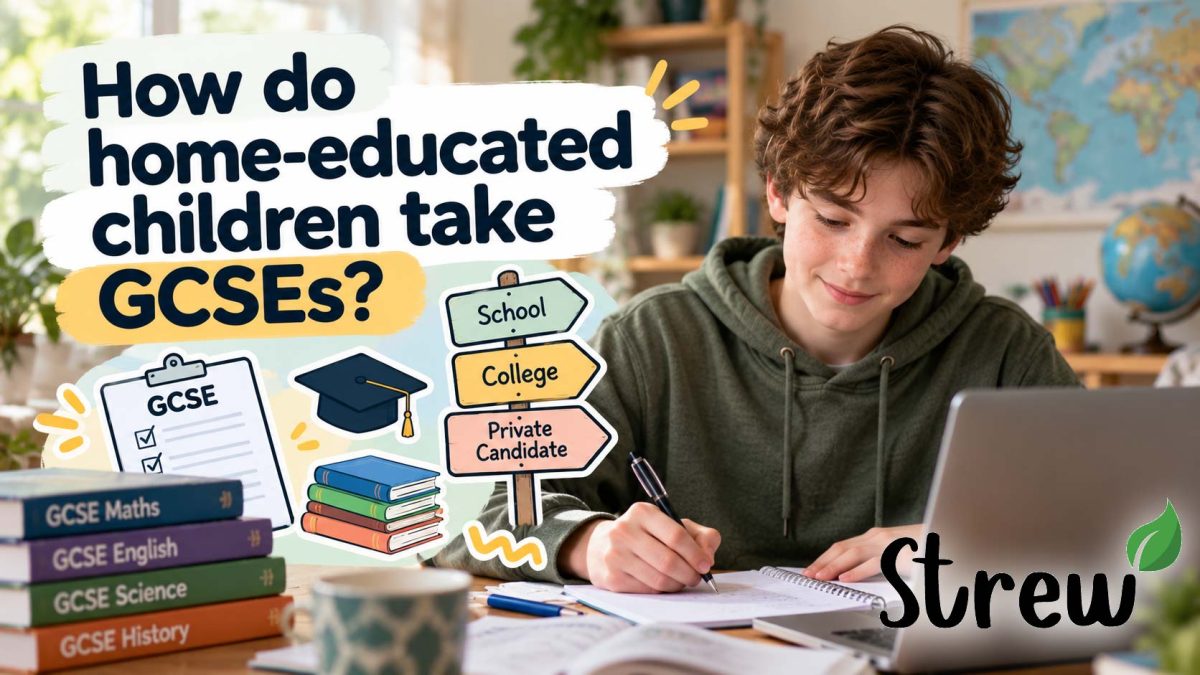
Can home-educated children take GCSEs?
Yes. Being home educated does not prevent a young person from gaining GCSEs.
A home-educated child can study independently, with their parents, through an online course, with a tutor or using another learning provider. When it comes to the exam itself, a private candidate needs to register with a school, college or other approved exam centre. (Source: GOV.UK)
They do not need to enrol at a mainstream school simply to obtain GCSE qualifications.
How do you book GCSEs as a private candidate?
The usual process is:
- Decide which subjects and qualifications your child wants to take.
- Choose the exam board and specification they will study.
- Find an exam centre willing to accept private candidates.
- Register and pay the centre’s fees.
- Sit the examinations or assessments at the centre.
The JCQ private candidate search tool can help families find centres offering GCSE examinations to private candidates.
Not every school or college accepts private candidates, and individual centres set their own fees and registration deadlines. It is therefore worth finding a centre before committing to a particular exam specification.
Do parents have to pay for home-educated GCSEs?
If you arrange GCSEs independently as a private candidate, you will normally be responsible for arranging the entry and paying the associated fees.
Costs can vary by subject and exam centre, so check directly with potential centres before choosing your child’s subjects.
There may also be other routes available locally. For example, some colleges and education providers offer programmes through which home-educated young people can work towards qualifications. Availability and eligibility vary, so this is something to investigate in your own area.
Think about coursework and practical assessments early
Not every GCSE is equally straightforward to take privately.
Some qualifications include non-exam assessment (NEA), coursework or practical requirements. Private candidates need an exam centre capable of providing the necessary assessment arrangements.
This makes it important to consider the exact qualification and exam board early, rather than simply deciding that your child will “do GCSE Biology” or another subject later.
Some home-educating families also consider International GCSEs (IGCSEs), particularly where a particular specification is easier to access as a private candidate.
Does a home-educated child have to take GCSEs?
No. Home education itself does not require a child to take GCSEs.
Whether GCSEs are useful depends on what your child wants to do next. If they are considering college, university, an apprenticeship or a particular career, look at the entry requirements early enough to plan backwards from them.
Similarly, home educators do not have to follow the National Curriculum simply because their child might eventually take GCSEs. Our guide explains whether home educators have to follow the National Curriculum.
Keeping track of learning before GCSEs
GCSE preparation may only represent part of a teenager’s education. They might also be learning through projects, reading, practical skills, hobbies, trips, online courses and independent interests.
Keeping a simple home education learning log can help you and your child see that development over time. If you need a more formal overview later, those records can also be turned into a home education report.
Using Strew
Strew lets you quickly record learning activities, photos, subjects and skills as your child progresses through home education. Its optional AI Learning Insights can also suggest skills and learning that may be present in an activity, helping you build a useful record alongside any formal GCSE preparation.
Video transcript
Do home-educated children do their GCSEs?
Yes. But how they do their GCSEs really depends on the child.
Some children enter the school system for the last few years of their education and work towards their GCSEs there. Some colleges also offer routes into GCSEs for home-educated young people.
They don’t necessarily need to attend a mainstream school. Home-educated children can also take GCSEs as private candidates by arranging their exams through an approved exam centre.
I think it’s important to remember that throughout the educational process leading up to GCSEs, there’s going to be a lot of learning across different subject areas.
If your child is considering moving into school, for example, towards the end of their education, having useful records can help you explain what that child has learned, their passions and interests, and areas where they might need additional support.
That’s where Strew comes in.
Strew is an app you can download on your phone to quickly and easily record your child’s learning. The AI Assistant can look at an activity you’ve entered and help identify possible learning outcomes.
So even if you’re struggling to describe what your child might have learned, the AI Assistant can give you a nudge based on the activity you’ve recorded.
It’s really simple to use. You can download Strew on the Google Play Store or iOS.
Alternatively, if you’re just looking for tips, follow @strewapp below, or join our home-ed newsletter.



Leave a Reply