
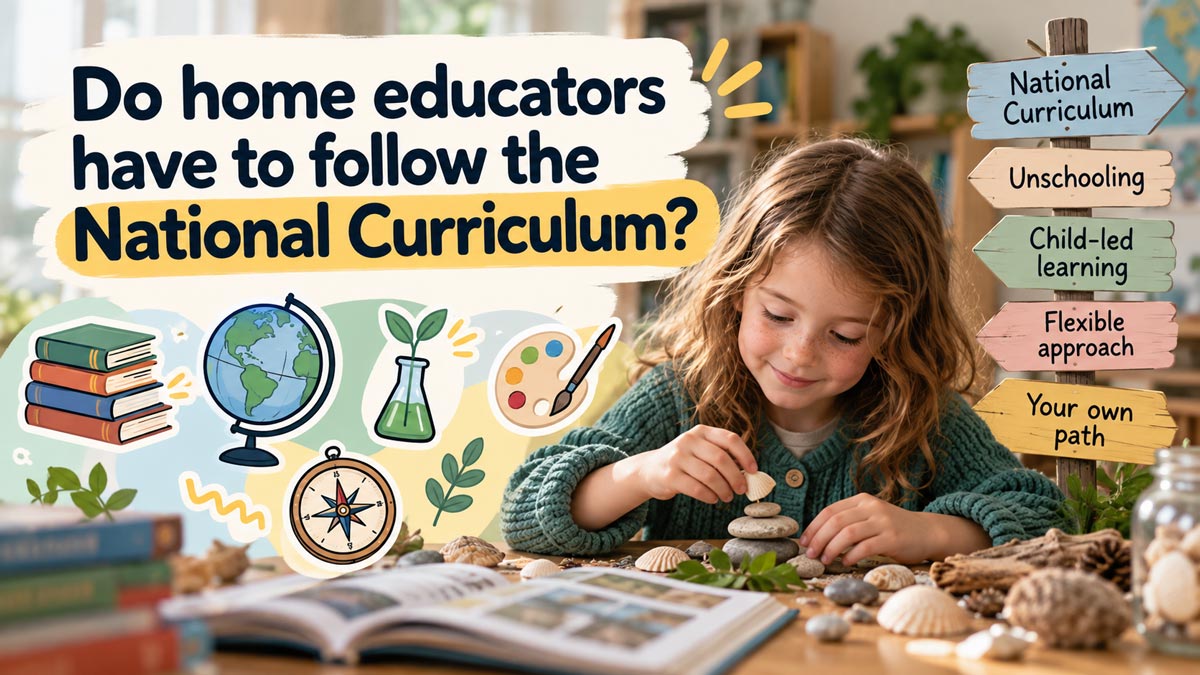
Do home educators have to follow the national curriculum? No. If you home educate your child in England, you do not have to follow the National Curriculum.
You can choose your own subjects, resources and approach, but you are responsible for ensuring your child receives an efficient, full-time education suitable for their age, ability, aptitude and any special educational needs, (reference Gov.uk).
What do home educators have to teach?
There isn’t a prescribed list of National Curriculum subjects that every home-educated child must study.
Department for Education guidance specifically says that home-educating parents are not legally required to:
- teach the National Curriculum
- provide a “broad and balanced” curriculum
- give formal lessons
- make detailed lesson plans
- formally assess their child’s progress
- work towards particular qualifications
- match school-based age standards
What matters is whether the education itself is suitable for your individual child. You can read more about what suitable home education means here.
Do home educators have to teach maths and English?
There is no rule saying a home-educated child must study school subjects called “Maths” and “English” or follow the National Curriculum programmes for those subjects.
However, this doesn’t mean literacy and numeracy can simply be ignored. DfE guidance says local authorities may use minimum expectations for literacy and numeracy when assessing whether a child’s education is suitable, (reference Gov.uk).
How those skills are learned can look very different from school.
Maths might develop through cooking, budgeting, games, building projects or a structured maths programme. Literacy might come through reading, writing stories, researching interests, conversations and everyday communication.
Can you use the National Curriculum anyway?
Absolutely. Not being required to follow it doesn’t mean you can’t use it.
Some families use the National Curriculum as a framework so they can see roughly what children in school are learning. This may also be useful if you expect your child to return to school later.
Others prefer a structured home education approach using their own curriculum, resources and routine.
And some families move much further away from conventional schooling through child-led learning, unschooling, project-based learning or a mixture of approaches.
There isn’t one required method. Strew’s guide to different home education styles gives an overview of the main approaches.
Do you need to recreate school at home?
No. Home education does not have to mean sitting at a desk from 9am until 3pm and recreating classroom lessons.
Learning can happen through projects, books, conversations, trips, practical skills, online resources, formal lessons and everyday experiences.
The important distinction is that you have flexibility over how you educate, but you still have responsibility for providing a suitable education.
That freedom is one of the reasons home education can look so different from one family to another.
Using Strew
Whatever approach you choose, Strew’s home education learning log lets you record lessons, projects, trips and everyday learning in the same place. This can make it easier to look back at what your child has actually been learning without forcing your home education into a school-style curriculum.
Video transcript
Do I need to teach my child the National Curriculum when they’re home educated?
Absolutely not.
As the parent who has taken responsibility for their education, you can choose how you educate them, provided you’re giving them a suitable education.
You don’t have to teach Maths and English in the same way they’re taught at school. Most of us can agree that some skills are fundamental, but it’s up to you how you teach your child those skills.
Don’t forget, just because our National Curriculum looks the way it does doesn’t mean education looks the same all over the world.
If you want to use the National Curriculum as a guide, you can.
Some parents go for an unschooling approach, which moves away from the idea of school and takes a child-led approach. Others go for something more flexible, with some structured work around core subjects and more hands-on experiences with subjects like geography and history.
And don’t worry if you feel like you don’t know everything, because most people don’t.
The beauty of home education is that you can learn with your child. You can learn the subjects they need to learn if you can’t remember them from your own school days.
Although, if you can’t remember them from your school days, what does that say about school?
It is useful to keep a record of that learning.
If you’re looking for more tips, follow Strew or visit strew.app. And if you’re already home educating and looking for a quick and easy way to track your child’s learning, you can download Strew on iOS and Android.



Leave a Reply