
Examples of learning evidence for home education records and reports
Evidence of learning is anything that helps show what your child has been learning, exploring, practising or developing over time.
This knowledgebase article explains what counts as evidence of learning, how broad it can be, and how to record it in a useful way:
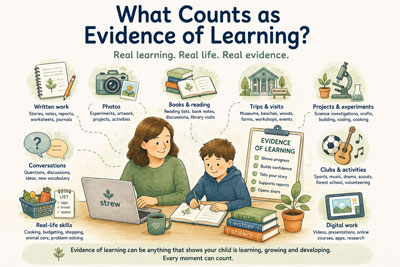
Evidence of Learning
- What is evidence of learning?
- Examples of evidence of learning
- Does it need to be schoolwork?
- How much evidence should you keep?
- Recording evidence in Strew
- Evidence of learning tips
What is evidence of learning?
Evidence of learning is any record, example, note, photo, activity, project or piece of work that helps demonstrate your child’s education.
It can show what your child has done, what they understood, what they practised, what questions they asked, what progress they made, or what interests they followed.
For home educating families, evidence of learning can be useful for:
- Keeping your own learning records
- Creating a home education report
- Reflecting on progress over time
- Remembering books, trips, projects and activities
- Responding to local authority enquiries, if needed
- Building a portfolio for future courses or applications
Examples of evidence of learning
Evidence does not have to be complicated. It can include everyday learning as well as more formal work.
- Written work: stories, notes, reports, worksheets, journals, handwriting practice or project pages.
- Photos: pictures of experiments, artwork, models, nature walks, practical projects or places visited.
- Books and reading: reading lists, book notes, audiobooks, library visits or conversations about stories.
- Projects: topic work, crafts, science investigations, building, coding, gardening, cooking or making.
- Trips and visits: museums, beaches, woods, farms, castles, workshops, libraries or community events.
- Conversations: discussions that show curiosity, understanding, reasoning or new vocabulary.
- Clubs and activities: sports, music, drama, Scouts, Guides, forest school, swimming, volunteering or group learning.
- Real-life skills: budgeting, shopping, cooking, animal care, planning, problem-solving, travel or household tasks.
- Digital work: videos, presentations, photos, online courses, apps, coding projects or research.
- Creative work: drawing, painting, music, storytelling, design, photography, craft or performance.
A short note beside an activity can often make the evidence much more useful. For example, instead of only recording “baking”, you might write that your child measured ingredients, doubled a recipe, discussed yeast, followed instructions and compared results.
Does evidence need to be schoolwork?
No. Evidence of learning does not have to look like schoolwork.
Home education can include formal lessons, but it can also include practical learning, child-led projects, conversation, reading, play, outdoor activities, life skills and real-world experiences.
A worksheet may be useful evidence, but so might:
- A photo of a den your child designed and built
- A note about a conversation on Roman roads after visiting a local site
- A list of books read over a month
- A photo of a science experiment
- A recording of a presentation or music practice
- A project summary about wildlife found in your garden
The important question is not “does this look like school?” but “does this help show learning, development, curiosity, skills or understanding?”
How much evidence should you keep?
There is no single correct amount.
Some families keep detailed portfolios. Others keep light notes, occasional photos and a summary report. The best system is usually the one you can keep using without it becoming a burden.
As a practical starting point, you might keep:
- A few activity notes each week
- Photos of practical or creative work
- A simple book or reading list
- Examples of written work, where relevant
- Short summaries of projects, trips or interests
You do not need to document every moment of your child’s life. Aim for a clear, balanced picture of learning over time.
Recording evidence in Strew
Strew is designed to make evidence of learning easier to capture as it happens.
You can use Strew to record:
- Activities and learning notes
- Photos and examples
- Books and reading
- Projects, trips and everyday learning
- Study Points across different areas of learning
- AI-assisted learning outcomes and summaries
Over time, these records can be used to create a clearer home education report or learning portfolio.
For more help, you may also find these guides useful:
- How to Create a Home Education Report
- Generating and Printing PDF Reports
- Evidence of Learning Glossary
Evidence of Learning Tips
> Add context
A photo is useful. A photo with a short note explaining what happened, what your child tried, or what they learned is even better.
> Capture real-life learning
Cooking, shopping, gardening, building, nature walks, conversations and hobbies can all provide strong evidence of learning.
> Keep it manageable
You are not trying to create a school filing system. A few meaningful records kept consistently are usually more useful than an overcomplicated system you stop using.
> Show progress over time
Try to include examples from different points in the year so you can see how your child’s skills, confidence and interests develop.
> Use your child’s interests
If your child is fascinated by dinosaurs, Minecraft, animals, space, baking or trains, those interests can become rich evidence of reading, writing, maths, science, communication, design, research and problem-solving.

If you have any questions, issues with Strew; printing or otherwise, please Contact Us. Likewise if you’d like a knowledgebase article on a specific Strew feature, just let us know!