
The Children’s Wellbeing and Schools Act 2026 introduces new registration requirements for children not in school in England and Wales. Once the relevant provisions are in force, parents covered by the requirements will need to provide information about their child, who provides their education, and estimated education time. They will not automatically have to submit detailed lesson plans or learning outcomes.
The Act has received Royal Assent, but that does not mean every registration requirement is already in force. Parents should check the commencement arrangements and any subsequent regulations before relying on a particular deadline.
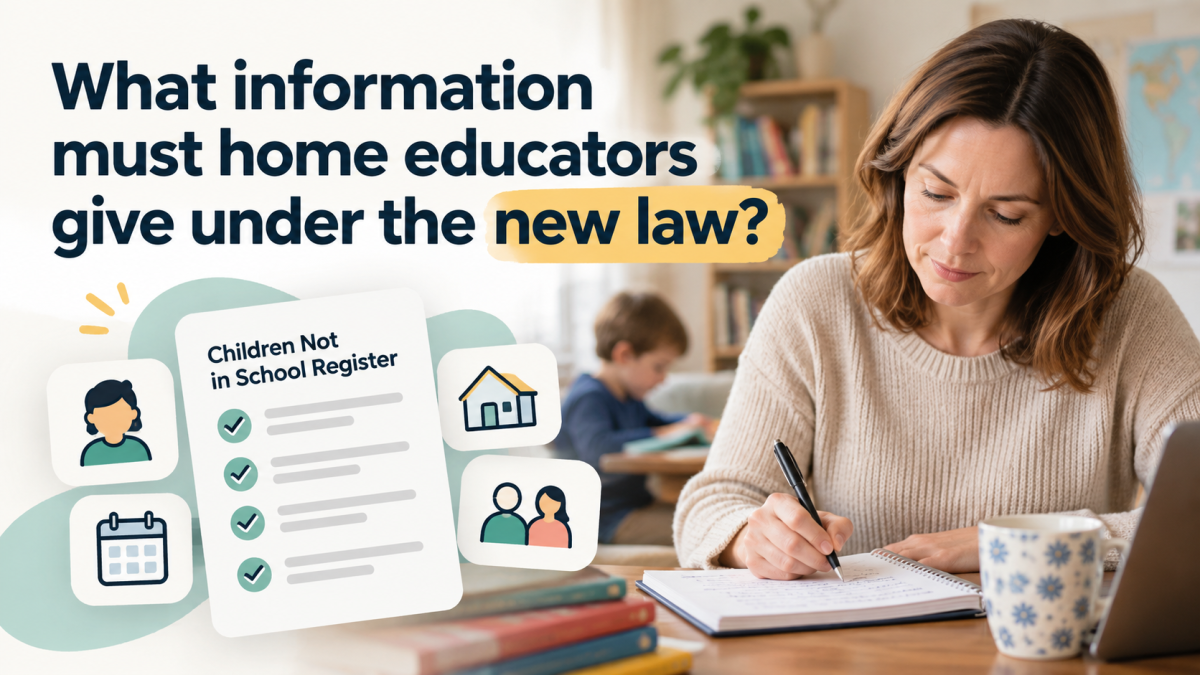
What information will parents need to provide?
Section 38 of the Act inserts sections 436B to 436G into the Education Act 1996. Section 436C sets out the information that local authorities must include in their registers, while section 436D establishes parents’ information-sharing duties.
(Legislation.gov.uk)
The core information includes:
- Your child’s details: Their name, date of birth, home address, previous address if they have lived at their current address for less than 12 months, and any additional address where they live.
- Parents’ details: The name and home address of each parent, together with the names of the parents providing education.
- Education time: An estimate of the overall time your child spends receiving education from parents and an estimate of the time spent receiving education from other people.
- Other education providers: Where a non-parent provider exceeds a threshold to be set in regulations, additional details about that provider, the education setting and the time involved.
The law asks parents to provide information they have. For example, its explanatory notes clarify that parents are not expected to obtain the details of an estranged parent that they do not know.
Will parents have to record their home education hours?
Parents covered by the new registration duties will need to provide estimates of education time. The legislation also allows further regulations to specify how those estimates should be calculated and recorded.
This is not the same as requiring a school-style timetable or a minute-by-minute record of every activity. The law distinguishes between time spent receiving education from parents and time spent receiving education from other people.
If you want to prepare, a simple weekly record could make estimating that time easier. You might note activities, approximate durations, who was involved and any learning that took place.
Will parents have to provide regular updates?
Under section 436D, once the relevant duties commence, parents will generally have 15 days from their child’s becoming eligible for registration to notify the local authority and supply the required information.
Parents will also need to report specified changes, such as changes to addresses or which parent provides education. Local authorities must request updates about education time and relevant providers at least annually, but cannot make those particular update requests more frequently than once every three months.
Do you need to record learning outcomes?
The new registration provisions do not impose a general requirement to submit individual learning outcomes for every activity.
Nevertheless, keeping a record of what your child has been doing and learning can help you understand their progress and explain their education if questions arise.
For example, a cooking activity might involve reading, measuring, budgeting and practical skills. A short note and a photograph could help you remember the activity without turning it into a formal lesson.
You can keep records in a notebook, spreadsheet, photographs or a dedicated app. The important distinction is between information the law requires you to provide and additional records you choose to keep for your own purposes.
Using Strew
Strew lets you record home education activities, approximate study time and learning outcomes on your phone. Its optional AI assistance can help identify learning within everyday activities, making it easier to build a useful record without having to document everything from memory.
Video transcript
What information will parents have to give?
This is probably one of the most important videos for parents.
Section 38 of the Act creates new sections 436B through to 436G. So what parts of the Act are changing?
The register can include information such as the child’s name, date of birth or home address, and previous address if they’ve lived there for less than 12 months.
They will need parents’ addresses and information regarding which parent will be providing the majority of the education, including how much time would be spent weekly providing that education.
The question is, though, what does this mean for home educators?
Quite simply, home educating parents need to start thinking about how they’re going to record the education they provide for their child.
That can be the amount of hours they spend, the learning outcomes that child will achieve and how they achieve those learning outcomes.
How you record that information is completely up to you.
Where the Strew app comes in is that it gives you a really smart app on your phone where you can very quickly and simply log learning activities, including learning outcomes.
You can monitor their progress in different subject areas, and you can use the AI assistive tool to make it super simple when it comes to identifying different learning outcomes that your child has achieved when you didn’t expect it.
You can download Strew today on the Google Play Store or on iOS.



Leave a Reply