
Home-educated children can socialise through home education groups, clubs, sports, Forest School, community activities, friends, family and everyday life. They don’t need to attend school to have regular opportunities to build friendships, communicate and spend time with other children and adults.
The opportunities available will vary depending on your area and your child’s interests.
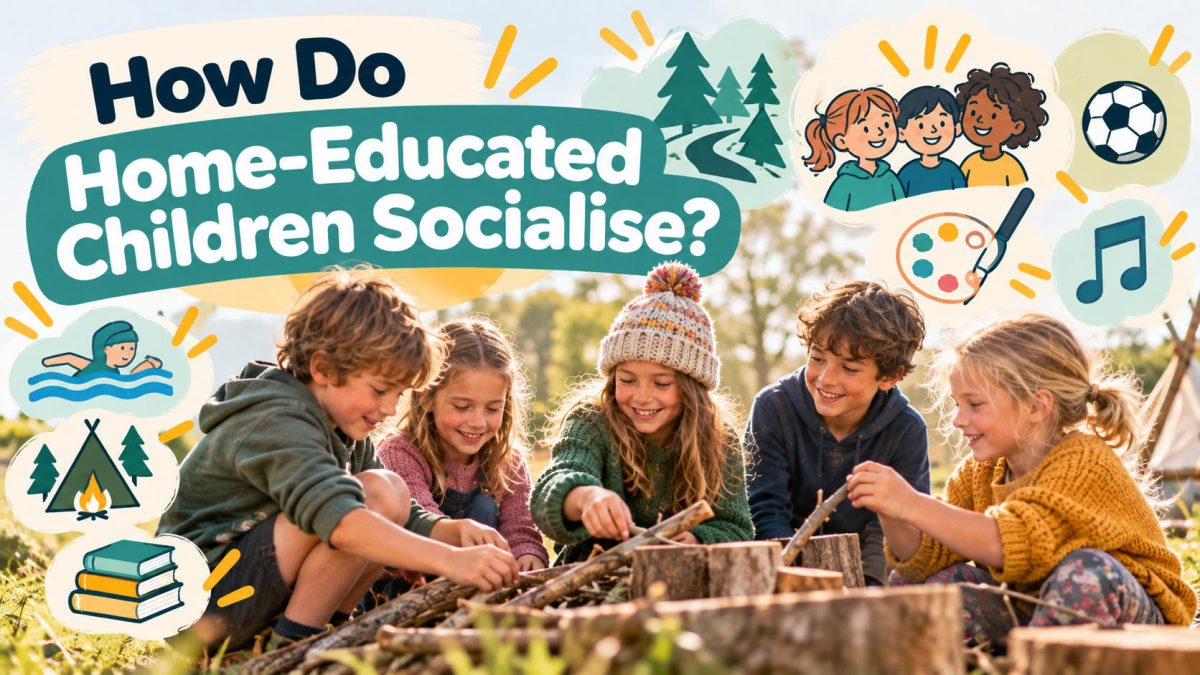
Where do home-educated children meet other children?
Home education doesn’t necessarily mean spending most of the week at home.
Depending on where you live, social opportunities might include:
- local home education groups and meet-ups
- sports clubs and swimming
- Scouts, Guides and similar organisations
- drama, music and art groups
- Forest School
- community groups
- library activities
- organised home education classes
- friends and extended family
- informal meet-ups with other home educating families
Some activities combine socialising and learning particularly naturally.
For example, a home education Forest School session might involve children building a shelter together. Alongside spending time with other children, they’re communicating, negotiating, sharing ideas, solving problems and developing practical skills.
Socialisation doesn’t have to look like school
Socialisation is broader than spending six hours each day with a class of similarly aged children.
Home-educated children may spend time with people of different ages in different environments: younger and older children at a home ed group, adults during everyday activities, instructors at clubs, extended family and children they meet through hobbies.
What matters more practically is whether your child has meaningful opportunities to form relationships, communicate, cooperate and spend time with other people.
For families using an eclectic approach to home education, groups and social activities can simply form another part of the overall week alongside lessons, projects, trips and learning at home.
Social activities can involve lots of learning
It’s also easy to overlook how much learning happens when children are doing things together.
A board game with friends might involve reading, mental maths, strategy, communication and learning how to handle winning and losing.
Building something together could involve teamwork, measurement, design and problem-solving.
A sports session might involve physical development, listening to instructions, cooperation and persistence.
That doesn’t mean you need to turn every social experience into a lesson. It’s simply worth recognising that social and educational experiences often overlap.
Strew’s guide to what counts as evidence of learning includes clubs, sports, group learning and other real-life activities alongside more traditional examples of learning.
Do you need to record your child’s socialisation?
There is no general requirement to keep a log of every time your home-educated child socialises.
However, you might find it useful for your own records.
It can be surprisingly difficult to remember how many groups, clubs, trips, play sessions and activities happened six months ago. Occasionally recording them gives you a better picture of your child’s experiences over time.
You also don’t need to record every interaction. A short note when something feels meaningful is enough.
Using Strew
Strew can be used to record social and group activities alongside the rest of your child’s learning. You might log a Forest School morning, sports session, home ed meet-up or collaborative project and add a quick note about what happened.
Over time, this gives you something concrete to look back on, both to see your child’s experiences for yourself and to understand the learning that happened alongside them.
Video transcript
One question home educators get all the time is: does your home-educated child even socialise?
Most of us will agree, yes.
Sometimes, as a home-educating parent, it can be really difficult to remember all of the socialising your child has done.
Not many people think to record that socialising, and now it’s simpler than ever to do that and give yourself some reassurance and peace of mind.
I use an app such as Strew.
You can record the times your child has socialised in a group environment. You may even find that they’ve been playing games or doing tasks that incorporate other learning.
The Strew AI Assistant can help you identify some of that possible learning.
So, when you’ve logged these experiences over time, you’ve got something to look back on and can see how much socialisation and how many different learning experiences your child has had.
You can download Strew from the Google Play Store or on iOS.



Leave a Reply