
A practical guide for home educating families
“Suitable education” is one of the most important ideas in home education law. It means your child’s education should be appropriate for their age, ability, aptitude and any special educational needs they may have.
This knowledgebase article explains what suitable education means in practice, and how you can show that your child is learning in a way that works for them:
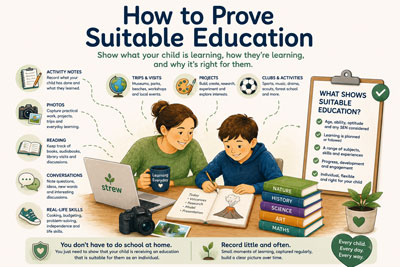
Suitable Education
- What is suitable education?
- What does “prove” suitable education mean?
- What evidence can you use?
- What if your education is child-led?
- What if your child has SEN?
- Recording suitable education in Strew
- Suitable education tips
What is suitable education?
In England, parents are responsible for making sure their child receives an efficient, full-time education suitable to their age, ability and aptitude, and to any special educational needs they may have.
For home educated children, suitable education does not usually mean copying school at home. You do not have to follow the National Curriculum, keep school hours, use formal lessons every day, or produce school-style work for every subject.
Instead, the key question is whether your child is receiving an education that fits them as an individual.
Suitable education may include:
- Structured lessons or planned learning
- Child-led projects and interests
- Reading, writing, maths and communication
- Science, history, geography, art, music and practical skills
- Outdoor learning, trips, clubs and community activities
- Everyday learning such as cooking, budgeting, gardening or problem-solving
- Adjustments for your child’s needs, pace, confidence or learning style
What does “prove” suitable education mean?
Many parents worry that they need to “prove” home education in a formal or school-like way. In practice, it is usually more helpful to think in terms of explaining and demonstrating your provision.
You are not trying to prove that every minute of every day is educational. You are trying to give a clear picture of:
- What your child is learning
- How they are learning
- Why your approach suits them
- How their needs are being met
- What progress, development or engagement can be seen over time
This might be done through a written report, examples of work, photos, reading lists, project notes, activity summaries, or a portfolio of learning evidence.
A good explanation is often more useful than a large pile of disconnected evidence.
What evidence can you use?
Evidence of suitable education can take many forms. It does not need to be limited to worksheets or formal written work.
You might include:
- Activity notes: short summaries of what your child has done and what they learned.
- Photos: practical work, projects, experiments, artwork, trips or outdoor learning.
- Written work: stories, journals, handwriting, reports, notes or maths practice.
- Reading records: books read, audiobooks, library visits or discussions about books.
- Project summaries: longer interests, investigations or topics explored over time.
- Conversation notes: questions asked, ideas discussed, new vocabulary or reasoning shown.
- Clubs and activities: sports, music, forest school, workshops, volunteering or group learning.
- Life skills: cooking, shopping, budgeting, animal care, travel, planning and problem-solving.
- Progress examples: before-and-after examples showing improvement, confidence or independence.
If you are creating a report, try to choose examples that show a range of learning rather than everything your child has ever done.
You may also find this article useful: What Counts as Evidence of Learning?
What if your education is child-led?
Child-led home education can still be suitable education.
The important part is being able to explain how your child’s interests are supporting learning and development. For example, a child interested in Minecraft might also be developing skills in reading, design, planning, maths, problem-solving, collaboration, storytelling or coding.
When recording child-led learning, it can help to note:
- What your child was interested in
- What questions they asked
- What resources they used
- What skills they practised
- What conversations or discoveries followed
- How the interest developed over time
You do not need to force child-led learning into school subject boxes, but it can be useful to describe the learning clearly so that someone else can understand its value.
What if your child has SEN?
If your child has special educational needs, suitable education should take those needs into account.
That may mean your education looks different from another family’s. It might involve a slower pace, shorter activities, more sensory breaks, practical learning, visual resources, fewer written tasks, interest-led work, extra repetition or a focus on confidence and regulation.
Useful evidence might include:
- Adjustments you make for your child’s needs
- Activities that build communication, confidence or independence
- Progress in life skills or emotional regulation
- Examples of learning through special interests
- Notes showing what works well and what does not
- Reports or recommendations from professionals, if you choose to include them
The aim is not to compare your child to a standard school pathway. The aim is to show that their education is suitable for them.
Recording suitable education in Strew
Strew helps you build a record of your child’s learning over time, so you are not trying to remember everything at the last minute.
You can use Strew to record:
- Learning activities and notes
- Photos and examples of work
- Books, trips, projects and conversations
- Study Points across different areas of learning
- AI-assisted learning outcomes and summaries
- PDF reports that bring your records together clearly
This can make it easier to create a clear home education report showing what your child has been learning and how your approach is supporting them.
For related help, see:
- How to Create a Home Education Report
- Generating and Printing PDF Reports
- Suitable Education Glossary
Suitable Education Tips
> Explain your approach
A short explanation of how you home educate can make your evidence much easier to understand.
> Show a range of learning
Include examples from different areas: reading, communication, maths, practical skills, projects, outdoor learning, creativity and real-life experiences.
> Link examples to your child
Suitable education is about your child. Explain why your approach works for their age, ability, aptitude, interests and needs.
> Include progress, not perfection
You do not need to show perfect work. Evidence of trying, practising, improving, becoming more confident or asking better questions can be just as valuable.
> Keep records little and often
It is much easier to show suitable education if you capture small pieces of learning throughout the year rather than trying to build a full picture from memory.

If you have any questions, issues with Strew; printing or otherwise, please Contact Us. Likewise if you’d like a knowledgebase article on a specific Strew feature, just let us know!