
To identify learning outcomes in home education, look beyond the activity itself and ask what skills, knowledge or understanding your child used or developed. An everyday activity can involve several areas of learning that aren’t immediately obvious.
You don’t need to turn every activity into a formal lesson. Sometimes it’s simply useful to recognise how much learning is already happening.
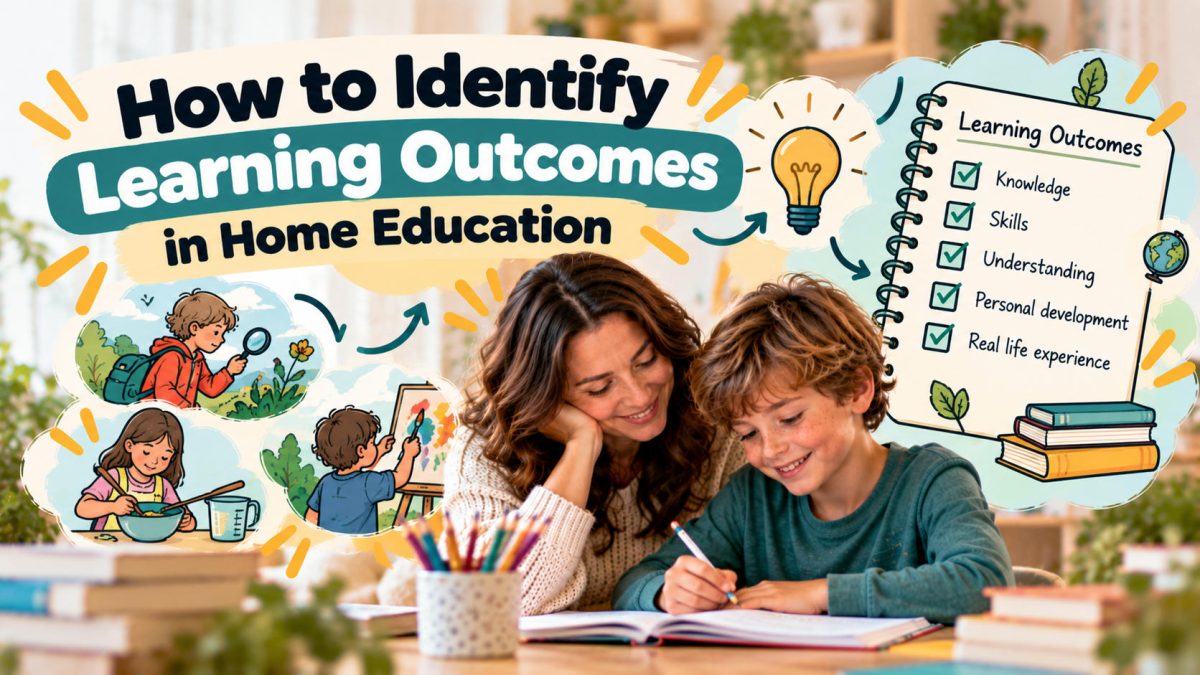
Look beyond the activity itself
Imagine your child decides to bake a cake.
On the surface, the activity is simply “baking”. Look more closely, though, and it could involve:
- reading and following instructions
- measuring quantities
- understanding fractions
- sequencing tasks
- managing time
- observing physical and chemical changes
- problem-solving
- developing practical independence
Likewise, building a den could involve spatial reasoning, planning, problem-solving and teamwork. Planning a day trip might involve research, budgeting, maps, communication and decision-making.
The point isn’t to attach as many educational labels as possible. It’s to notice meaningful learning that might otherwise be overlooked.
This can be particularly useful for child-led learning
Learning outcomes can be relatively obvious when you’re following a structured lesson with a defined objective.
They’re often less obvious when education happens through projects, hobbies, play, conversations and everyday life.
That’s one reason recording child-led learning can initially feel difficult. A child might spend an afternoon completely absorbed in an activity without anybody stopping to label the individual skills they’re using.
Looking back at what actually happened can reveal those connections without changing the way your child learns.
A simple way to spot learning outcomes yourself
When recording an activity, ask a few questions:
What did they have to know?
Did they use existing knowledge about numbers, language, nature, technology or another subject?
What did they have to do?
Think about skills such as measuring, reading, researching, designing, comparing, communicating or making decisions.
What problems did they encounter?
Working something out, changing an approach or correcting a mistake can be an important part of learning.
What was new?
Did they discover something, improve a skill or understand an idea differently afterwards?
You don’t need to answer every question. Even one or two observations can turn a vague note into a useful learning record.
Strew’s guide to home education learning logs has examples of how short everyday entries can capture this without creating lots of extra paperwork.
Using AI to suggest learning outcomes
Strew’s AI Learning Assistant is designed to help with this process.
When you log an activity, you can write a quick description of what happened. The AI can then suggest concepts, skills and possible learning outcomes contained within that activity.
These should be treated as suggestions, not authoritative assessments of what your child has achieved. You know the child and the activity; AI only has the information you’ve given it.
Its useful role is to prompt you to notice things you might have missed.
For example, you might record a woodworking project because your child enjoyed making something. The suggested outcomes could prompt you to recognise the measurement, geometry, planning, tool skills and problem-solving involved too.
Using Strew
Strew lets you keep these observations alongside the original activity rather than creating a separate educational write-up. You can also use activity tags to organise learning by subjects, skills or your own categories.
Over time, this can make patterns in your child’s learning easier to see, whether you follow a structured, mixed, unschooling or child-led approach.
Video transcript
I just found a bunch of different educational outcomes that I wasn’t even aware my child had been developing. It was thanks to the Strew AI Assistant tool.
Basically, it’s a bit of a hack to understand where your child’s progress is within their learning.
Every time you’re logging an activity in the app for something they’ve done, the AI Assistant takes those quick notes that parents leave when they’re trying to record what they’ve done.
The AI Assistant uses them to understand what the task was and what the child was doing. Then, at the end, it’ll suggest different educational learning outcomes that the child may have achieved by doing the activity you’ve just described.
Sometimes there’ll be areas where you think, “Oh, I didn’t realise they’d done this, this and this within that task.”
What it does is translate daily informal learning into clear educational outcomes, and it reduces paperwork and admin, which is what we all want.
Whether you’re doing unschooling, child-led learning or taking a more structured, formal approach, it allows you to see what outcomes your child could be hitting without even realising.



Leave a Reply