
What Is a Suitable Education for Home Education?
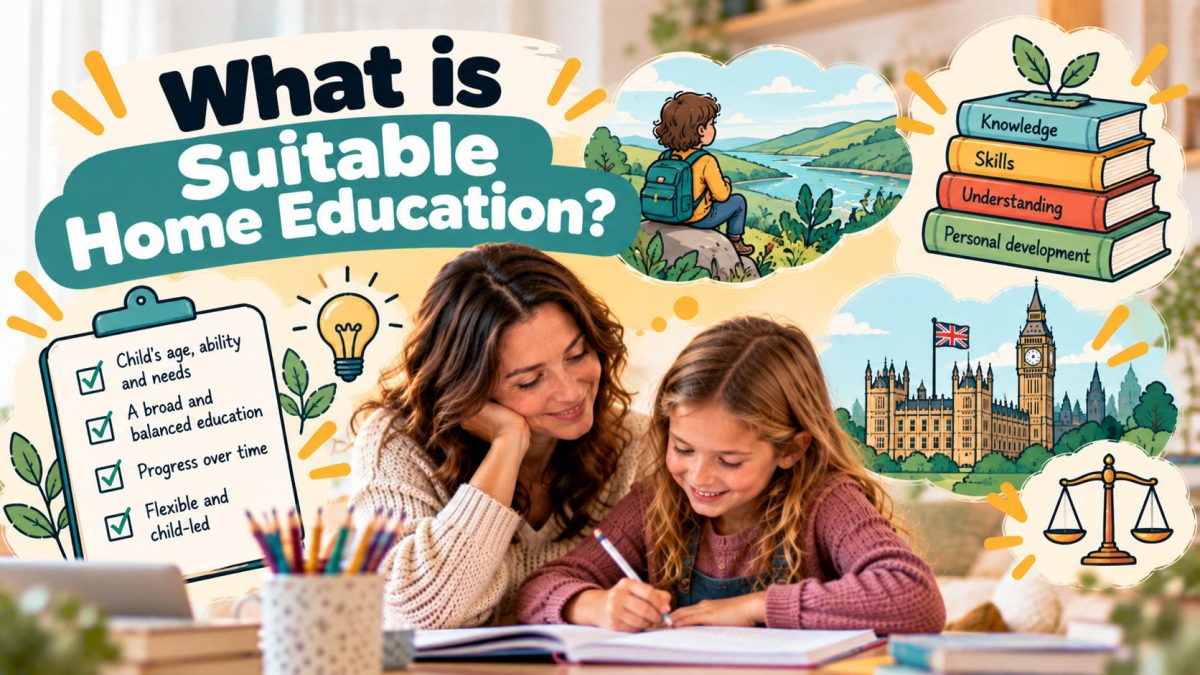
In England, home-educating parents must provide an efficient, full-time education suitable to their child’s age, ability, aptitude and any special educational needs. It does not have to look like school, follow the National Curriculum or use a particular teaching method.
If your local authority makes enquiries, being able to clearly explain your approach and give examples of your child’s learning can help demonstrate that the education you’re providing is suitable.
What does “suitable education” actually mean?
The legal starting point is Section 7 of the Education Act 1996. Parents must ensure that children of compulsory school age receive an efficient, full-time education suitable to their:
- age
- ability
- aptitude
- any special educational needs they may have
The law does not prescribe one particular style of home education.
Your approach might be structured, child-led, project-based, autonomous or a mixture. You don’t have to recreate a school environment or follow the National Curriculum.
For more detail on the legal position, see Strew’s guide to home education law in the UK.
How do you show that your home education is suitable?
There isn’t one required form of evidence or official portfolio that every home educator must produce.
However, your local authority has responsibilities relating to children who may not be receiving a suitable education. If it makes enquiries about your child’s education, useful information might include:
- examples of written or practical work
- photographs of projects and activities
- books and reading
- educational trips and visits
- projects and interests your child has explored
- short notes explaining activities and what was learned
- evidence of progress over time
- a written summary or home education report
The important part is context. A folder containing hundreds of photos tells someone relatively little on its own. A smaller selection of dated examples with a sentence explaining what your child was doing and learning can provide a much clearer picture.
See what counts as evidence of learning for more practical examples.
You don’t need to record everything
Keeping evidence doesn’t mean documenting every hour of home education.
In fact, trying to do that can quickly turn home education into an administrative exercise. Instead, aim to keep enough information to give a clear picture of what your child is learning and how their education is developing over time.
That might mean occasionally saving a photo, recording a book, writing a few sentences about an activity or keeping examples of work.
If you’re eventually asked for a written summary, those small records can make it much easier to create one. Strew also has home education report examples showing how different approaches, including child-led learning, can be presented clearly.
Using Strew to keep evidence
Strew lets you log home education activities as they happen, including notes, photos and books. You can also add learning outcomes and Study Points to help organise and understand learning over time.
If you later want a summary of that learning, Strew can turn the activities you’ve recorded into a home education report rather than requiring you to search back through photos, notes and messages.
The app doesn’t determine whether an education is legally suitable. It simply gives you an easier way to keep useful records and present what your child has actually been doing.
Video transcript
What is a suitable education, and how do we prove it?
Home education doesn’t need to look like a school environment. Providing a suitable education for your child depends on their age and their ability, basically what works for them.
That might be unschooling, a mixed approach or child-led.
But there may be a time when we need to demonstrate that suitable education. How do we do that?
There are many different ways that you can show suitable education. This can be through photographs, copies of the work they’ve done, their written journals or your own written reports.
However, one thing that we do find is that this can create a lot of administrative work and paperwork.
What we tend to find is parents will do activities with their children, take some pictures and leave notes on their phone. They might even use some of the popular social media apps to try to keep a record of it.
The difficulty is that when the time comes, you then have to go back through all of that information just to record it.
There are easy guides on the Strew website, and don’t forget the Strew app allows you to quickly and easily log activities that you’ve done with your child, including adding photos and scanning book barcodes so you know which books they’ve been reading.
You can even use the AI assistant tool, Learning Outcomes and Study Points to make the whole thing simple and effective for learning and understanding progress.
Then, if the time comes when you need to demonstrate that suitable education, you can go on the Strew app and print off a report of the learning they’ve been doing to go alongside the information you send to the local authority.
You can download the app on iOS or the Google Play Store. It takes a matter of minutes to download and sign up, and you can start logging activities straight away.



Leave a Reply