
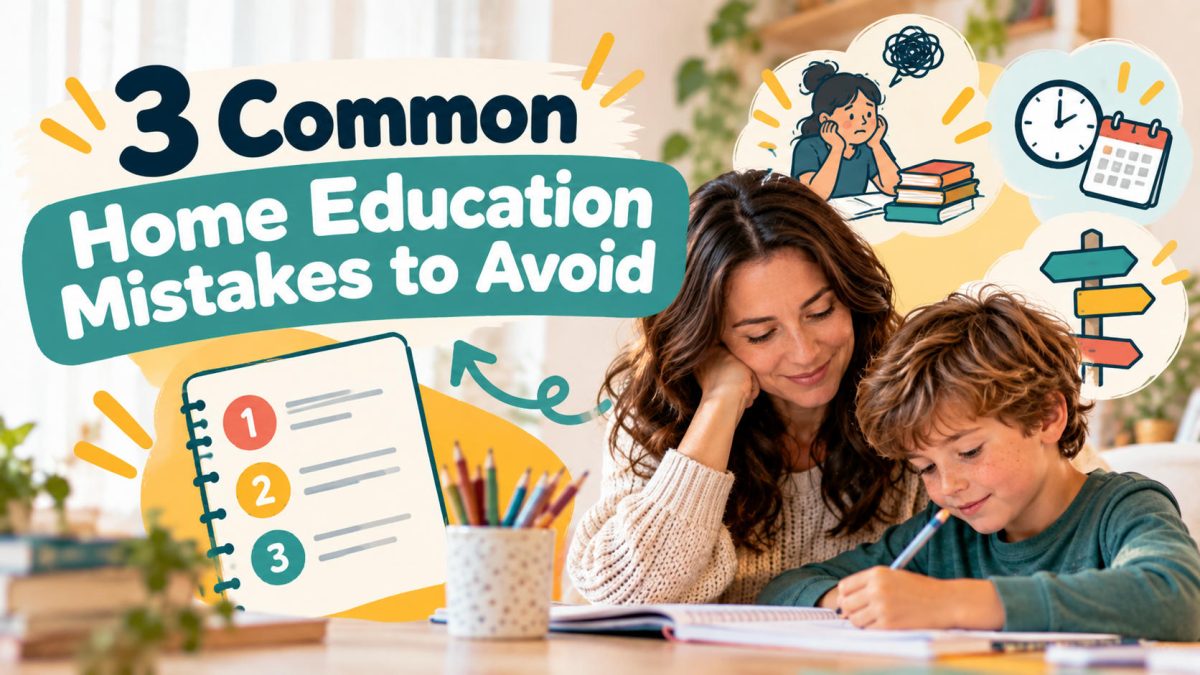
Three common mistakes when you start home educating are putting too much pressure on yourself, failing to keep any useful record of learning, and assuming home education has to recreate school at home.
There isn’t one correct way to home educate. Finding an approach that works for your child and your family is usually more useful than trying to reproduce somebody else’s version of home education.
1. Putting too much pressure on yourself
Taking responsibility for your child’s education can feel enormous.
Suddenly you’re thinking about maths, reading, science, socialisation, progress, resources and whether you’re doing enough. It’s easy to feel that every day needs to be packed with obviously “educational” activities.
It doesn’t.
Home education can happen through structured lessons, projects, books, conversations, trips, practical activities and ordinary life. You also don’t have to commit permanently to one particular philosophy.
Strew’s overview of different home education styles is useful if you’re still figuring out what works. You might be structured, child-led, relaxed, project-based or a mixture of several approaches.
2. Not keeping any record of what you’ve done
You don’t need to record everything your child does.
But keeping nothing at all can make it surprisingly difficult to remember how much learning has happened.
Six months later, you might remember the big museum trip but forget the books, conversations, experiments, cooking, research, games and little projects that grew from it.
Short notes and occasional photos can help you see the bigger picture.
This can be particularly useful with approaches such as worldschooling, where education can happen through places, travel, culture and real-world experiences rather than obvious lessons.
Do you have to keep records for the council?
There is no general requirement in England to maintain a particular type of home education record or portfolio.
Local authorities can, however, make informal enquiries to establish whether a child appears to be receiving a suitable education. Parents are not legally required to produce specific forms of evidence in response to those informal enquiries, although providing insufficient information can lead the authority to conclude that suitable education has not been demonstrated.
Keeping some useful records can therefore make explaining your home education much easier, but that is different from needing to document every activity.
3. Trying to recreate school at home
Leaving school doesn’t mean your kitchen table needs to become another classroom.
In England, home-educating families don’t have to follow the National Curriculum. The education does need to be full-time and suitable for your child’s age, ability, aptitude and any special educational needs.
For some children, structured lessons and timetables work brilliantly.
For others, they don’t.
You might discover that your child learns better through projects, practical activities or following particular interests. An eclectic approach to home education can also combine structured learning in some areas with much more flexible learning elsewhere.
The useful question isn’t “Does this look enough like school?”
It’s “Is this approach helping my child learn?”
Using Strew
Strew can help with the second mistake in particular. Instead of relying on your memory, you can quickly record activities as they happen and gradually build a picture of your child’s education.
That record can also be reassuring for you. Looking back over several months often makes learning that felt scattered day-to-day much easier to see.
Video transcript
What are three mistakes home-educating parents make?
This is going to be a good one.
Number one, and the most important because everybody does it, is putting too much pressure on yourself.
The weight of a child’s education, especially your own child’s, can be huge. It’s quite easy to put pressure on yourself. You need to find a way that you can remember and record the things that you’ve done with your child.
Leading on from step one, step two is recording the information.
Yes, it is your right to home educate your child. However, the local authority does have responsibilities relating to children who may not be receiving a suitable education.
That’s where recording information properly doesn’t only reassure you, but also means you’ve got something you can look back on if you need to explain the education you’re providing.
And three, and this happened to me, you try to be like school.
The likelihood is school wasn’t working, and replicating school probably isn’t going to work. For some children it might, but in my experience it didn’t.
Take it easy. Listen to your child and listen to yourself. What works for you? What works for your family?
Creating that suitable education can be fun, creative and surprisingly easy.
Remember, keeping a useful record of what you’re doing means you can look back on all the amazing things you’ve achieved.
The Strew app can help you do that. It’s super simple and easy, and you can use the AI Assistant to help identify and organise possible learning from the activities you’ve recorded.
You can download Strew on iOS or the Google Play Store, get more information on the website and enjoy home education.



Leave a Reply