
The Children’s Wellbeing and Schools Act 2026 introduces significant changes for home education in England and Wales, including Children Not in School registers and new duties for parents to provide certain information to their local authority. However, the new system does not mean parents must follow the National Curriculum or submit a school-style annual report.
The Act became law in April 2026, but the new Children Not in School provisions need to be commenced before the new system operates in practice.
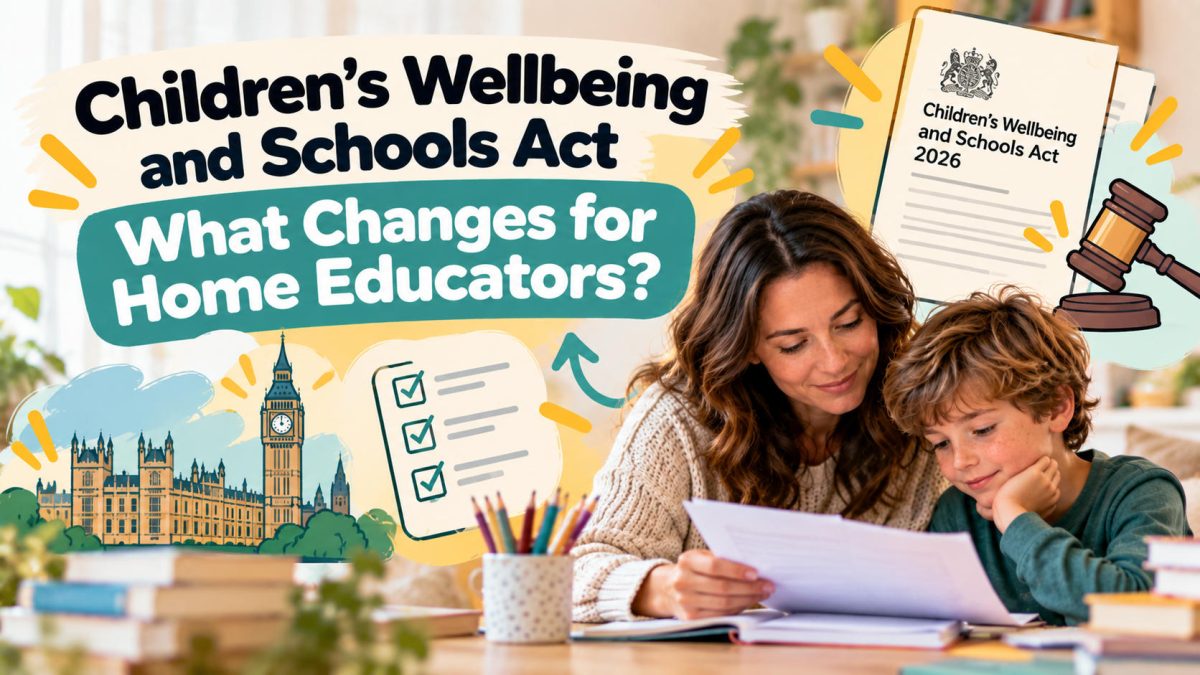
What is changing for home-educating families?
One of the biggest changes is the introduction of a Children Not in School (CNIS) register.
Under the new legislation, local authorities in England and Wales will be required to maintain a register of eligible compulsory-school-age children who are not receiving all of their education at a relevant school.
This will include many home-educated children.
You can read Strew’s plain-English explanation of the Children Not in School register for more detail.
What information will parents have to provide?
Once the relevant provisions are in force, parents of eligible children will have duties to provide specified information for the register.
The legislation provides for information including:
- the child’s name and date of birth
- home address and certain previous or additional addresses
- parents’ names and addresses
- which parent or parents are providing education
- an estimate of how much time the child spends being educated by their parents
- information about education provided by other people in relevant circumstances
Parents will also have duties to notify the local authority of certain changes. Some changes must be notified within 15 days, while some information about changes to education must be provided when requested by the local authority.
This is more formal than the current arrangements for many home-educating families.
For context on what a council currently does in relation to home education, see Strew’s explanation of the role of a local authority.
Does this mean you need to record every lesson?
No.
The new legislation creates information requirements, but it does not say that every home-educating parent must maintain a school-style learning log or produce an annual report containing everything their child has done.
The underlying parental responsibility remains to provide an efficient, full-time education suitable to the child’s age, ability, aptitude and any special educational needs.
That duty comes from Section 7 of the Education Act 1996.
Keeping useful records may nevertheless make it easier to explain your child’s education if information is requested.
Other changes home educators should know about
The Act goes beyond simply creating a register.
It also introduces additional rules around local authority consent before some children can be withdrawn from school for home education. These provisions particularly affect certain children with current or recent child-protection involvement and children in specified special-school circumstances.
The legislation also gives local authorities new responsibilities around considering children’s home and other learning environments. Under the new registration provisions, a local authority will have a power to request a home visit within 15 days of registration.
That doesn’t mean every home-educating family will automatically receive a compulsory home inspection. The legislation distinguishes between the authority considering the home environment and its power to request a visit.
Should you start keeping records now?
You don’t need to panic or suddenly document every hour of your child’s day.
But keeping simple, useful records of activities, projects, books, trips and other learning can be worthwhile regardless of the legislation.
A few notes and photos recorded as you go are much easier to work with than trying to reconstruct months of learning later.
Using Strew
Strew’s home education Learning Log lets you record activities, notes and photos as learning happens and review them later.
That doesn’t replace any legal responsibility or automatically satisfy a local authority request. It simply gives you an organised record to work from if you need to explain or present your child’s education.
Video transcript
Home educators, what do the changes in legislation mean?
There are upcoming changes to legislation. As a home-educating parent, there will be more responsibility on you to provide information to the local authority.
Try not to panic.
One of the things you can do is start recording your child’s learning thoroughly now. It’s really simple to do.
Some parents might use paper and pen. Others might use social media apps. More and more parents are choosing to use dedicated apps, something that takes away some of that administrative work and puts it into one quick and easy solution.
Parents are downloading the Strew app.
The Strew app gives you a home where you can log your child’s learning activities and outcomes, use its AI tool to make things easier and use Study Points to make it fun.
If you later want a report showing the learning your child has been doing, you can quickly generate one from the information you’ve entered.
Don’t forget, this doesn’t take away your responsibilities to the local authority. It’s simply designed to make keeping and presenting your records easier.
Strew is available on the Google Play Store and iOS App Store. It takes seconds to download and register, and you can start recording today.



Leave a Reply