
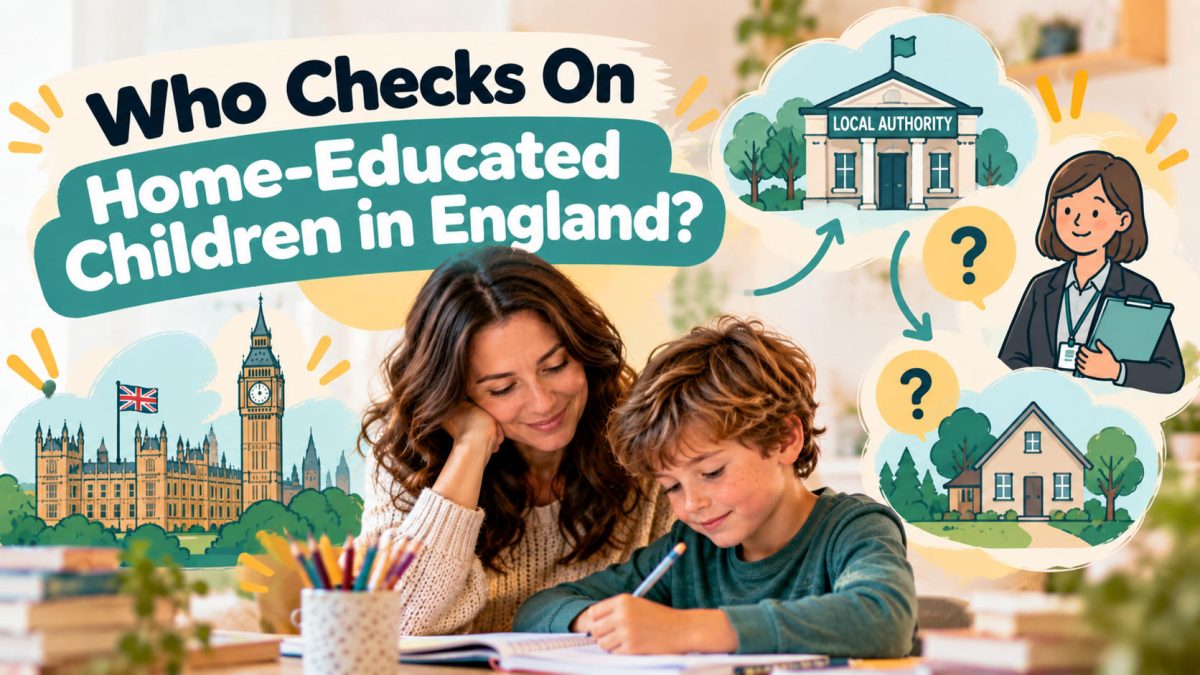
In England, parents are responsible for providing a suitable education, while the local authority can make enquiries to establish whether a home-educated child appears to be receiving one. There is no school-style inspection system for ordinary elective home education, and councils do not formally assess every home-educated child in the same way.
How and when your council contacts you can vary between local authorities.
What is the local authority responsible for?
Parents have the legal responsibility to ensure that a child of compulsory school age receives an efficient, full-time education suitable to their age, ability, aptitude and any special educational needs.
Local authorities have a different responsibility. They have duties relating to identifying children who are not receiving a suitable education.
Because of this, your council can make informal enquiries about the education you’re providing. GOV.UK specifically states that councils can make an informal enquiry to check that a child is receiving a suitable education at home.
If you’re new to the terminology, Strew’s guide to Elective Home Education (EHE) explains what EHE means and how it differs from education provided by a school.
Will the council check every year?
There isn’t a single national timetable that says every home-educating family must have an annual assessment.
Department for Education guidance recommends that local authorities maintain contact with home-educating families, and many councils make contact roughly annually. However, the exact process and frequency varies according to the local authority and individual circumstances.
So you might receive a request for an update after a year, but it isn’t accurate to say that every home educator automatically goes through the same annual review process.
Your council should publish its own Elective Home Education policy explaining its approach.
What might the council ask about?
An informal enquiry is generally concerned with whether your child appears to be receiving an efficient, full-time and suitable education.
There isn’t one prescribed form of evidence you have to maintain.
Information you choose to provide could include:
- a written description of your approach
- examples of activities or projects
- photographs of practical learning
- books and resources your child has used
- examples of work
- interests your child has explored
- examples of development and progress
If much of your learning is practical, keeping occasional photo learning records can be an easy way of preserving useful examples without creating lots of paperwork.
Likewise, if reading is a significant part of your home education, something as simple as a record of books your child has read can help build a picture over time.
Keeping records before you’re asked
You don’t need to document every moment of home education.
But if you decide to keep records, doing a little at a time is much easier than trying to reconstruct a year of learning from your memory, camera roll and old messages.
A short note and occasional photo can be enough to remind you what happened and why it mattered.
Using Strew
Strew lets you record activities, photos and books as learning happens. Its AI Learning Assistant can also suggest skills or learning areas that might be involved in an activity you’ve described.
Those AI suggestions aren’t an assessment of what your child has definitely learned. They’re prompts that can help you describe learning you have observed yourself.
If your local authority later asks about the education you’re providing, you then have an organised record to refer back to rather than starting from memory.
Video transcript
Who checks on the progress of home-educated children?
As a parent of a home-educated child, it is your responsibility to provide a suitable education.
Typically, when you deregister your child from school, the local authority may get in touch to ask about how you’re going to provide that suitable education for your child.
Following this, many local authorities will contact home-educating families periodically to ask for an update on the education being provided.
It’s often at this point that people start to panic. It’s really hard to capture all of the learning that you do over a long period of time.
But that doesn’t mean you need to worry. You can start thinking proactively about how you record it.
Parents record their children’s learning in lots of different ways. How you prepare now can change how easy it is to present later.
Some parents use social media apps. Some parents keep handwritten documents and paperwork. Some parents use apps such as Strew, where you can quickly and easily enter the learning activity that your child has done.
You can add pictures if you want, scan a book and enter a little bit of information.
If you’re not sure what learning might have been involved in an activity, the AI Assistant can suggest possible learning outcomes and skills based on what you’ve recorded.
Even when an activity doesn’t immediately look educational, there can be lots of learning involved.
If you want more information, you can find Strew on the Google Play Store or Apple’s App Store.



Leave a Reply