
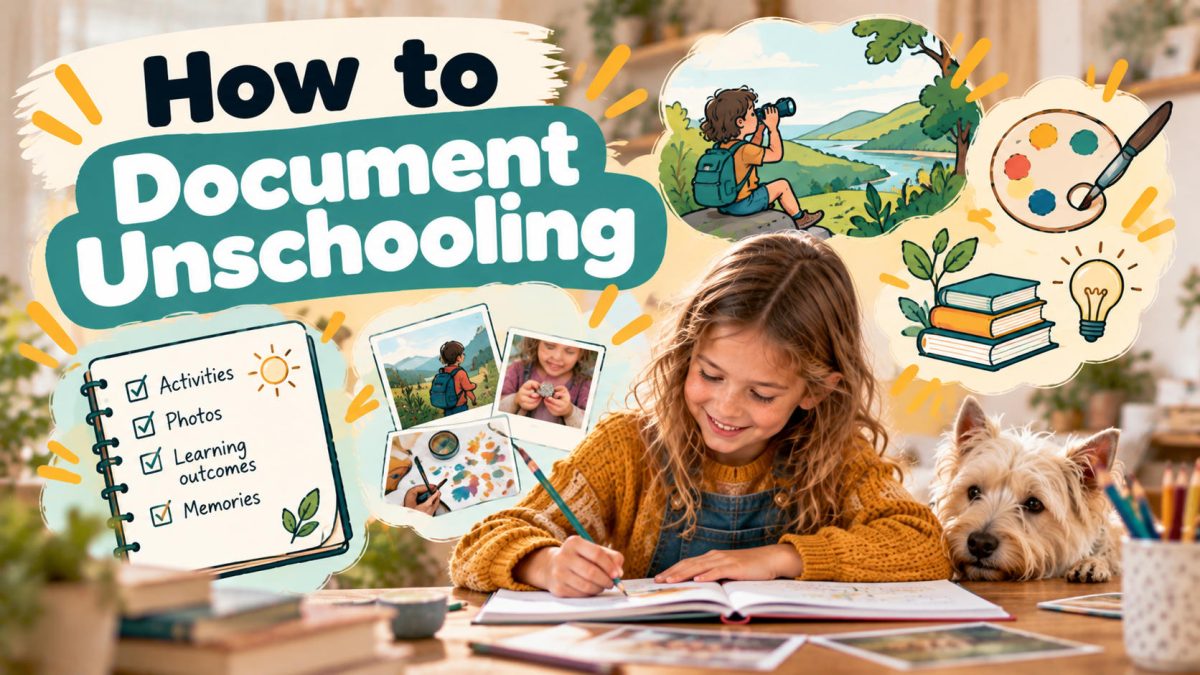
You can document unschooling by keeping brief records of meaningful everyday learning, such as projects, conversations, books, games, trips, practical skills and interests. You do not need to record everything or turn child-led learning into school-style lessons simply to create a useful record.
The aim is to capture enough to see how learning develops over time without getting in the way of the learning itself.
What does learning look like in unschooling?
Unschooling doesn’t mean an absence of education. Learning is led by a child’s interests, curiosity and real-world experiences rather than being divided into predetermined lessons and subjects.
A day might involve cooking, gaming, building something, researching an animal, reading, visiting somewhere new or spending hours pursuing a particular hobby.
These activities can involve maths, literacy, science, communication, research, problem-solving and practical skills without anybody announcing that a lesson has started.
Strew’s complete guide to unschooling explores how this approach works in more detail.
How do you keep records when you unschool?
The challenge is that informal learning can be surprisingly easy to forget.
You might remember a big museum visit six months later, but not the conversation that led your child to spend three days researching Ancient Egypt afterwards.
A simple unschooling record could include:
- a quick note about an interest or activity
- photos of things your child made or explored
- books, documentaries, websites or other resources
- games and the skills involved
- trips and places visited
- questions and interesting conversations
- practical skills such as cooking, budgeting or gardening
- projects and how they developed over time
You don’t have to translate every experience into a school subject. Recording what actually happened is often more useful.
Do unschoolers need to document everything?
No.
There is no requirement in England for home educators to maintain an exhaustive diary of everything their child does.
Parents are responsible for ensuring their child receives a suitable full-time education. Local authorities can make informal enquiries to establish whether suitable education is being provided, but Department for Education guidance does not require parents to maintain a particular form of record or produce specific types of evidence.
Keeping some records can nevertheless be extremely useful, particularly with unschooling.
The key is little and often. A few meaningful entries each week may tell the story of your child’s education far better than trying to document every moment.
Recording real-life learning
One useful habit is to record an activity while it’s still fresh.
Instead of writing:
Made dinner.
You might record:
Chose a pasta recipe, checked which ingredients we already had, weighed everything independently and doubled the quantities for six people.
You haven’t turned dinner into a maths lesson. You’ve simply captured what actually happened.
The same principle works particularly well for project-based learning, where one interest or project can naturally develop across many different areas of learning.
Using Strew for unschooling
Strew’s Learning Log lets you quickly save notes and photos as learning happens, so you don’t have to reconstruct months of experiences from your camera roll later.
For unschooling families, the useful part is that those records don’t need to start with a curriculum or formal subject. You can record the real-life activity first and build a picture of your child’s interests, experiences and development over time.
Video transcript
Does Strew work if you take an unschooling approach? Absolutely.
I think if you take an unschooling approach, documenting the things you do and those real-life situations can be really useful.
Often people think that unschooling means no learning, no experiences, no anything. However, there is so much learning that happens in everyday life.
There are so many valuable opportunities that, if you don’t log them or keep track of them, later on you’re probably not going to remember them all.
Keeping a record can help you look back over that learning and, if you need to create a report, give you useful information to work from.
Strew is one of the best things I’ve found to help you do that.



Leave a Reply